
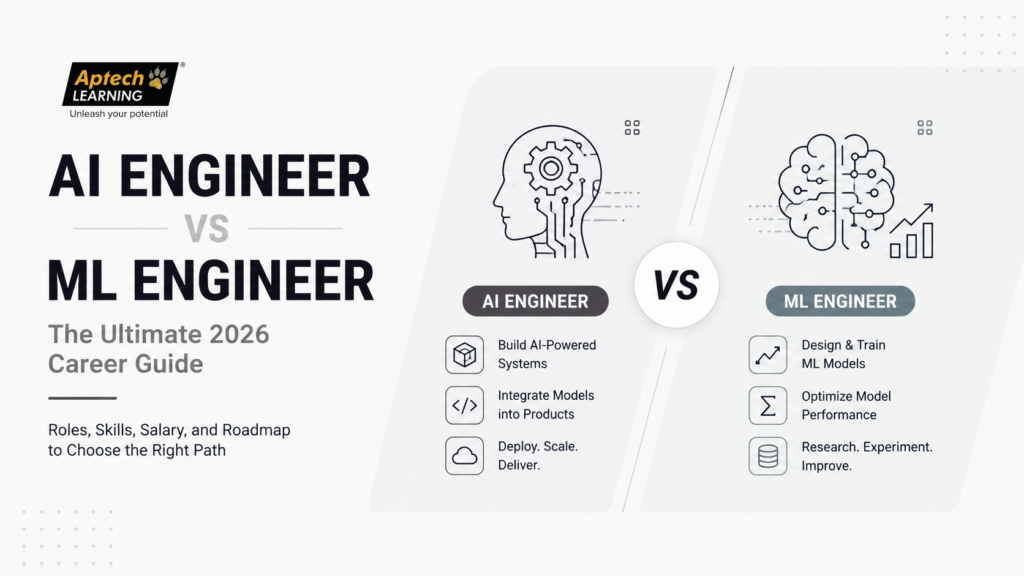
AI Engineer vs ML Engineer: An AI Engineer builds end-to-end AI-powered products and systems — integrating models into apps, APIs, and pipelines. An ML Engineer focuses on designing, training, and optimising machine learning models for scale and performance. Both roles need Python and data skills, but AI Engineers lean toward system architecture and deployment, while ML Engineers specialise in model research and mathematics.
AI Engineer vs ML Engineer: The Ultimate 2026 Career Guide (Don't Choose Wrong!)
Every year, thousands of aspiring tech professionals make the same costly mistake: they pick AI Engineer or ML Engineer without understanding what these roles actually demand — and end up wasting months of preparation, money, and opportunity. The AI Engineer vs ML Engineer debate is not just semantic; it is a career-defining decision that shapes your salary ceiling, daily work, required skills, and long-term growth.
India's AI and ML job market crossed 90,000+ open positions in 2024, with average salaries ranging from ₹8 LPA to ₹40 LPA depending on the role and specialisation (Source: LinkedIn Talent Insights, 2024). Yet most candidates applying for these jobs cannot clearly explain the difference between the two roles in an interview — let alone align their learning path with the right one.
In this definitive guide, you will discover the exact difference between an AI Engineer vs ML Engineer, what each role pays, which skills you need, the most common mistakes aspirants make, and a proven step-by-step roadmap to break into either career in 2026. Whether you are a student, a fresher, or a working professional looking to switch, this guide is written for you.
What is the Real Difference? (The Problem Nobody Explains Clearly)
If you Google 'AI Engineer vs ML Engineer' right now, you will find hundreds of articles that define both roles in abstract textbook language and then leave you more confused than before. That is the core problem. Most content treats these as interchangeable titles when the reality on the ground — in actual job descriptions and hiring briefs — is quite different.
Many companies use both titles loosely, some roles overlap significantly, and the Indian tech market often conflates data science, ML, and AI into a single job description. This blurs boundaries for job seekers.
At their core, the difference is this:
An AI Engineer builds AI-powered systems and products. They take existing models (sometimes built by ML Engineers or third-party APIs) and integrate them into scalable, production-ready applications. Think of them as the builders and deployers.
An ML Engineer is a specialist who designs, trains, fine-tunes, and evaluates machine learning models from scratch or from pre-trained bases. They spend more time with mathematics, algorithms, and model performance. Think of them as the researchers and optimisers.
Both are essential. Both are high-paying. But they require different strengths, different daily tasks, and different career investments.
AI Engineer vs ML Engineer — The Complete Comparison Table
| Factor | AI Engineer | ML Engineer | Overlap? | Edge Goes To |
|---|---|---|---|---|
| Primary Focus | Build AI products & systems | Design & train ML models | Partial | Context-dependent |
| Daily Tasks | APIs, pipelines, deployment | Model training, evaluation | Some | Different domains |
| Math Required | Moderate (applied) | Advanced (theoretical) | Basic stats | ML Engineer |
| Programming | Python, APIs, cloud tools | Python, PyTorch, TensorFlow | Python core | Equal |
| Work Environment | Product/engineering teams | Research/data science teams | Varies | Personal preference |
| Fresher Salary (India) | ₹6–10 LPA | ₹7–12 LPA | — | ML Engineer (slightly) |
| Senior Salary (India) | ₹20–40 LPA | ₹25–50 LPA | — | ML Engineer (top end) |
| Entry Barrier | Moderate | High | — | AI Engineer |
| Demand Growth (2026) | Very High | High | — | AI Engineer |
| Cloud Skills | Essential | Helpful | — | AI Engineer |
| Research Orientation | Low–Medium | High | — | ML Engineer |
| Time to Job-Ready | 6–12 months | 12–24 months | — | AI Engineer |
Why Most People Fail to Choose the Right Career Path
Career counsellors at Aptech Learning speak to hundreds of aspirants every month. The pattern is always the same: students pick a path based on hype, not honest self-assessment.
The Top Reasons Aspirants Choose Wrong:
- Following trends blindly: 'AI is hot, so I'll be an AI Engineer' — without understanding that true ML research demands strong mathematical foundations.
- Conflating job titles: Many job postings label the same role differently across companies. A candidate tailors for one title and misses relevant openings for the other.
- Ignoring self-assessment: Candidates who love building products and shipping features are naturally better suited for AI Engineering. Those who love experimentation, research, and math are better for ML Engineering.
- Choosing based on salary alone: The highest ML salaries require PhDs or years of research experience. Chasing that number without the right academic grounding leads to frustration.
- No structured learning path: Most self-learners cobble together YouTube tutorials and random Udemy courses with no coherent curriculum — and end up with gaps that disqualify them in interviews.
- Underestimating deployment skills: Even ML Engineers need to understand how models go into production. Ignoring MLOps concepts leads to a serious skill gap.
The fix is not more research. The fix is honest introspection combined with a structured, guided learning programme — which is exactly what industry-aligned courses at institutions like Aptech Learning are designed to provide.
What Does an AI Engineer Actually Do?
An AI Engineer is primarily a builder. They are responsible for creating applications and systems that use artificial intelligence to solve real-world business problems. While they must understand how ML models work, their primary role is not to train models from scratch but to integrate, deploy, and scale them.
Core Responsibilities of an AI Engineer:
- Integrating pre-trained models (GPT, BERT, DALL-E, etc.) into web, mobile, or enterprise applications.
- Building AI APIs and microservices that other applications can call.
- Designing and maintaining data pipelines that feed AI systems with quality data.
- Working with cloud platforms (AWS SageMaker, Google Vertex AI, Azure ML) for model hosting and scaling.
- Collaborating with product teams to define AI-powered features and user experiences.
- Monitoring deployed models for performance drift and retraining triggers.
- Prompt engineering and fine-tuning large language models (LLMs) for specific business use cases.
Key Tools & Technologies:
Languages
Python, JavaScript (for full-stack AI apps)
Frameworks
FastAPI, Flask, LangChain, LlamaIndex
Cloud
AWS, GCP, Azure — with ML services
Model Hubs
Hugging Face, OpenAI API, Anthropic Claude API
MLOps
Docker, Kubernetes, MLflow, CI/CD pipelines
Databases
Vector DBs (Pinecone, Weaviate), PostgreSQL
According to the World Economic Forum's Future of Jobs Report 2025, AI and Machine Learning Specialists are among the fastest-growing job categories globally, with AI Engineers particularly in demand as companies race to productise AI capabilities.
Authority Source: WEF Future of Jobs Report 2025 ↗What Does an ML Engineer Actually Do?
An ML Engineer sits at the intersection of data science and software engineering. They are specialists who design, develop, train, validate, and optimise machine learning models. Unlike data scientists who focus on analysis and insight, ML Engineers are focused on building models that are both accurate and production-scalable.
Core Responsibilities of an ML Engineer:
- Designing ML model architectures — CNNs, RNNs, Transformers, ensemble methods — for specific problems.
- Collecting, cleaning, labelling, and pre-processing training datasets.
- Training and evaluating models using metrics like accuracy, F1 score, AUC-ROC, BLEU, etc.
- Hyperparameter tuning and optimisation using techniques like Bayesian search, Grid/Random search.
- Running A/B experiments to compare model versions in production.
- Writing scalable, efficient ML code that can handle millions of data points.
- Implementing MLOps practices: versioning, monitoring, automated retraining.
- Collaborating with data engineers, research scientists, and product teams.
Key Tools & Technologies:
Languages
Python, R, Scala (for Spark-based pipelines)
Frameworks
TensorFlow, PyTorch, Scikit-learn, XGBoost, LightGBM
Data Tools
Apache Spark, Pandas, NumPy, SQL
MLOps
MLflow, DVC, Kubeflow, Weights & Biases
Cloud
SageMaker, Vertex AI, Databricks
Experiment Tracking
Wandb, Comet ML, Neptune.ai
AI Engineer vs ML Engineer: Salary Comparison 2026
Salary is one of the most-searched data points in the AI Engineer vs ML Engineer debate. Here is the full picture based on current Indian and global market data:
Sources: LinkedIn Salary Insights 2025, Glassdoor India, AmbitionBox, Levels.fyi
ML Engineers have a slightly higher salary ceiling due to the advanced specialisation required, but AI Engineers often reach senior salaries faster because the demand for deployment-ready talent is currently outpacing supply — especially in India's product startup ecosystem.
Skills Required: Side-by-Side Breakdown
| Skill Category | AI Engineer Needs | ML Engineer Needs |
|---|---|---|
| Mathematics | Linear algebra, basic stats (applied) | Linear algebra, calculus, prob. theory, optimisation (deep) |
| Programming | Python (advanced), REST APIs, async code | Python (advanced), Cython, performance optimisation |
| ML Knowledge | Understanding of model types, APIs | Model design, training loops, loss functions, evaluation |
| Deep Learning | Use pre-trained models, fine-tuning basics | Build and train DL architectures from scratch |
| Cloud Skills | Essential — AWS/GCP/Azure ML services | Helpful — focus on compute & GPU management |
| MLOps / DevOps | Docker, CI/CD, model serving, monitoring | DVC, MLflow, experiment tracking, retraining pipelines |
| Data Engineering | Pipeline integration, ETL, vector DBs | Feature engineering, large dataset handling, Spark |
| LLM / GenAI | Prompt engineering, RAG, LangChain | Fine-tuning LLMs, RLHF, model compression |
| System Design | Scalable AI system architecture (essential) | Scalable training infrastructure (helpful) |
| Domain Knowledge | Business + product understanding | Research papers + theoretical foundations |
Step-by-Step Roadmap to Become an AI or ML Engineer
🔷 Roadmap for AI Engineer (6–12 Month Plan)
Master Python, data structures, OOP, Git, and basic statistics. Understand APIs and HTTP fundamentals.
Learn core ML algorithms (regression, classification, clustering) using Scikit-learn. Build 2–3 projects.
Study CNNs, RNNs, and Transformers at a conceptual and applied level. Use Hugging Face to work with pre-trained models.
Learn to use OpenAI API, Claude API, Gemini. Build RAG-based chatbots using LangChain and vector databases like Pinecone.
Learn FastAPI for serving models. Understand microservices, Docker, and Kubernetes basics. Deploy your projects on AWS or GCP.
Set up CI/CD for ML models. Use MLflow for experiment tracking. Monitor models in production for drift.
Build 3–5 production-grade AI projects. Prepare for system design interviews. Apply with confidence.
🔶 Roadmap for ML Engineer (12–24 Month Plan)
Deep-dive into linear algebra, multivariate calculus, probability, and statistical inference. Resources: MIT OpenCourseWare, Khan Academy.
Advanced Python, NumPy, Pandas, SQL, and Matplotlib. Learn feature engineering and data pre-processing deeply.
Implement ML algorithms from scratch — gradient descent, SVM, decision trees, ensembles. Understand the math behind them.
Master PyTorch and TensorFlow. Build CNNs, RNNs, Attention mechanisms, and Transformer architectures from scratch.
Choose a domain — NLP, Computer Vision, Recommender Systems, or Time Series. Go deep in one area and build advanced projects.
Read and replicate landmark ML papers (BERT, ResNet, Stable Diffusion). Contribute to open-source ML projects.
Learn end-to-end model deployment with Kubeflow, SageMaker, and Databricks. Understand model monitoring at scale.
Publish project results on GitHub. Write technical blogs. Prepare for ML research interviews at FAANG-level companies.
Expert Strategy: How to Pick the Right Path for YOU
After years of training thousands of IT professionals, Aptech Learning's career counsellors have developed a simple but powerful decision framework. Ask yourself these five questions honestly:
If you are undecided, start with the AI Engineer path. The fundamentals you build — Python, ML basics, APIs, deployment — are valuable for both roles. You can always transition to ML Engineering later with specialised upskilling. It is far easier to go from AI Engineer to ML Engineer than the other way around.
7 Deadly Mistakes Beginners Make (And How to Avoid Them)
In the AI Engineer vs ML Engineer journey, the path is full of costly pitfalls. Here are the seven most common mistakes seen across thousands of learner profiles:
Many learners jump straight to LangChain or PyTorch without solid Python and statistics. This creates a brittle knowledge base that collapses under interview pressure.
Knowing how to run a Scikit-learn pipeline does not mean you understand machine learning. Interviewers probe concepts — bias-variance tradeoff, gradient descent, regularisation.
Jupyter notebooks are fine for learning, but every project on your portfolio needs to be a deployed application or a reproducible codebase.
ML models are worthless unless they are in production. Both AI and ML Engineers need MLOps skills.
Spending 18 months studying only Computer Vision without any deployment knowledge makes you narrow and hard to hire in the current market.
Technical skills alone will not land you the job. Communicating model decisions to non-technical stakeholders is a critical and often overlooked competency.
Self-learning is powerful but slow. Without a mentor or structured curriculum, you will spend months learning things in the wrong order.
Which Courses Help You Get There Faster?
The fastest way to break into AI or ML Engineering is through structured, industry-aligned training that combines theory with hands-on projects and real mentorship. Here is what to look for in a quality programme:
| Programme Feature | AI Engineer Path | ML Engineer Path |
|---|---|---|
| Python + Statistics Foundation | ✅ Essential | ✅ Essential |
| ML Algorithms In Depth | ⚡ Overview | ✅ Essential |
| Deep Learning (CNNs, Transformers) | ⚡ Applied Usage | ✅ Full Training |
| LLMs, GenAI, Prompt Engineering | ✅ Essential | ⚡ Research Focus |
| Cloud Platforms (AWS/GCP/Azure) | ✅ Essential | ⚡ Helpful |
| MLOps + Deployment | ✅ Essential | ✅ Essential |
| Project-Based Learning | ✅ 5+ Projects | ✅ 5+ Projects |
| Placement Support | ✅ Look for this | ✅ Look for this |
| Industry Certifications | ✅ NASSCOM, AWS | ✅ Google, Coursera |
| Mentorship by Practitioners | ✅ Essential | ✅ Essential |
Aptech Learning's IT programs are designed to cover all the above for both paths. With 39+ years of experience, NASSCOM-certified curriculum, 840+ training centres across India, and strong placement assistance, Aptech is one of India's most trusted names in tech education.
Why Choose Aptech Learning in Gurgaon for Your AI or ML Engineering Career?
If you are based in Gurgaon — or anywhere in the Delhi NCR region — you are sitting in one of India's most explosive tech hiring markets. Gurgaon is home to the Indian headquarters of Google, Microsoft, Accenture, Deloitte, IBM, American Express, and hundreds of AI-first product startups. The demand for trained AI Engineers and ML Engineers in this city is not just growing — it is outpacing the supply of qualified candidates right now.
That is exactly why choosing the right training institute in Gurgaon is not a minor decision. It is the decision that determines whether you get hired in 6 months or spend 2 years going in circles.
Aptech Learning in Gurgaon: Built for the Gurgaon Job Market
Aptech Learning's Gurgaon centre is not a generic coaching centre that runs the same programme everywhere in India. The curriculum, projects, and placement connections are aligned with the specific companies and roles hiring actively in the Gurgaon–Delhi NCR corridor.
Here is what sets the Gurgaon centre apart:
Industry-Aligned Curriculum for NCR Hiring
The course content is regularly updated based on what Gurgaon's top recruiters — in BFSI, IT services, ed-tech, and SaaS — are actually testing for in interviews. You learn what gets you hired, not what looked good in a textbook five years ago.
NASSCOM-Certified Training You Can Trust
Every programme at Aptech Learning carries NASSCOM certification — India's gold standard for IT education. When a Gurgaon recruiter sees "Aptech Learning — NASSCOM Certified" on your resume, it signals credibility that generic online certificates simply cannot match.
Trainers Who Have Done the Job, Not Just Taught It
You will learn from certified trainers who have real industry experience in AI, ML, Python, and cloud technologies — not just theoretical academics. This means the examples, projects, and advice you get are grounded in how actual Gurgaon tech companies work.
Project-Based Learning with a Job-Ready Portfolio
Courses are built around hands-on projects — not slides and notes. By the time you finish, you have a GitHub portfolio with real deployed AI/ML projects that Gurgaon interviewers can evaluate directly.
Dedicated Placement Assistance with NCR Employer Network
Aptech Learning has built relationships with hundreds of companies actively hiring from its Gurgaon centre. The placement team works with you on resume building, mock interviews, LinkedIn optimisation, and direct referrals — not just a job board login.
Flexible Timings for Working Professionals in Gurgaon
Switching careers while holding a job? Aptech Learning Gurgaon offers weekend batches, evening batches, and hybrid learning options — so your upskilling does not have to come at the cost of your current income.
Conveniently Located in Gurgaon's Tech Hub
The centre is accessible from key Gurgaon localities including Cyber City, MG Road, Sohna Road, Golf Course Road, and Sector 14 — making the daily commute easy whether you are coming from Gurgaon, Faridabad, or South Delhi.
Aptech Learning Gurgaon vs Self-Learning vs Random Online Courses
| Parameter | Aptech Learning Gurgaon | Self-Learning (YouTube/Udemy) | Random Online Course |
|---|---|---|---|
| Curriculum Structure | ✅ Structured & updated | ❌ Fragmented | ⚡ Partially structured |
| Industry Recognition | ✅ NASSCOM Certified | ❌ None | ⚡ Varies |
| Mentor Support | ✅ Live, personalised | ❌ None | ⚡ Forum-based only |
| Project Guidance | ✅ Guided real projects | ❌ Self-directed | ⚡ Generic assignments |
| Placement Help | ✅ Dedicated NCR network | ❌ None | ❌ None |
| Local Employer Connect | ✅ Gurgaon-specific | ❌ None | ❌ None |
| Peer Learning & Network | ✅ Batch environment | ❌ Isolated | ⚡ Limited |
| Flexible Timings | ✅ Weekday + Weekend | ✅ Anytime | ✅ Anytime |
| Time to Job-Ready | ✅ 6–12 months (guided) | ❌ 18–36 months (typically) | ⚡ 12–24 months |
What Gurgaon Students Are Saying
Thousands of students from Gurgaon and Delhi NCR have transformed their careers with Aptech Learning's structured AI and ML programs.
Join thousands of students from Gurgaon and Delhi NCR who have transformed their careers with Aptech Learning. Get expert guidance, a structured curriculum, and placement support — all in one place.
Frequently Asked Questions (FAQs)
Conclusion: Your AI Engineer vs ML Engineer Decision Starts Now
The AI Engineer vs ML Engineer debate ultimately comes down to one question: what kind of work energises you? If you love shipping products, building systems, and integrating intelligent capabilities into real applications, the AI Engineer path is your calling. If you love the rigour of model research, the satisfaction of squeezing out another point of accuracy, and the challenge of theoretical problem-solving, ML Engineering is where you will thrive.
Both roles are in extraordinary demand in 2026. Both offer salaries that can transform your financial future. And both require the same starting point: structured, consistent learning with real-world project experience.
The biggest risk is not choosing the wrong path — it is delaying the decision. Every month you wait is a month of salary, growth, and career momentum you leave on the table. The Indian AI and ML job market is growing fast, and companies are actively hiring across experience levels.
Start your AI Engineer vs ML Engineer journey with Aptech Learning. Explore our industry-aligned IT programs, speak to a career counsellor, and take your first step towards a high-growth tech career — today.
🚀 Launch Your AI/ML Career with Aptech Learning
India's Most Trusted IT Training Institute │ 39+ Years │ 840+ Centres │ NASSCOM Certified