

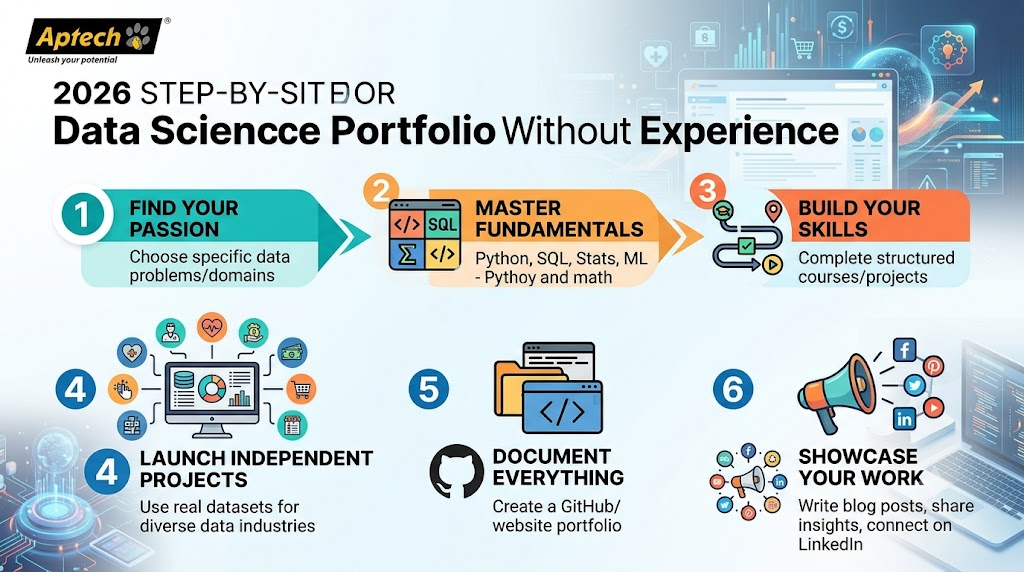
Breaking into data science without a job on your resume can feel like a chicken-and-egg problem — you need experience to get hired, but you need to get hired to gain experience. The good news is that in 2026, hiring managers no longer expect every entry-level candidate to have professional experience. What they do expect is proof that you can actually do the work, and that proof comes from your portfolio.
A well-built data science portfolio without work experience can carry as much weight as an internship on your resume — sometimes more. This guide walks you through exactly how to build one from scratch: what projects to pick, how to structure them, where to host them, and the mistakes that quietly sink most beginner portfolios.
Download Free Data Science Portfolio Blueprint (PDF)
Get instant access to complete project ideation checklists, GitHub README markdown templates, recruiter outreach scripts, and step-by-step portfolio formulas.
Why a Portfolio Matters More Than a Resume When You Have No Experience
Most entry-level data science applicants have little to no professional experience, so a resume alone can't prove much. A portfolio does what a resume can't — it shows your work in action. It's the difference between telling a recruiter "I know Python and machine learning" and showing them a working project where you used both to solve a real problem.
Recruiters and hiring managers today put a premium on business impact, not just technical execution. That means fundamentals like Python, SQL, machine learning, and data visualization are still non-negotiable, but they're no longer enough on their own — you need to show you can translate analysis into insight, and insight into a decision someone could actually act on.
Step 1: Get Your Fundamentals Genuinely Solid First
Before you touch a single project, make sure you actually understand the tools you'll be using. Trying to build a portfolio on shaky fundamentals usually backfires in interviews, when a hiring manager asks you to explain a design choice and you can't. Focus on:
- Python — pandas, NumPy, and at least one visualization library (matplotlib/seaborn or Plotly)
- SQL — most real data jobs require database work, so don't settle for basic SELECT queries; practice joins, window functions, and query optimization
- Statistics fundamentals — enough to justify why you picked a particular model or test
- One machine learning library — scikit-learn is the standard starting point
You don't need to master everything before you start — but each project should stretch a skill you've genuinely practiced, not one you're improvising for the first time.
Step 2: Pick Projects That Solve a Real Problem (Not Just Show Code)
This is where most beginner portfolios fail. A data scientist's core strength is answering real questions with data — a model is just the tool, not the point. Instead of picking a dataset because it's popular on Kaggle, pick a problem you can clearly explain in one sentence, and work backward from there.
Strong beginner project categories include:
- Data cleaning projects — take a genuinely messy, real-world dataset and document every cleaning decision and why you made it. Companies know raw data is messy; this alone is a valued, underrated skill.
- SQL case studies — go beyond basic queries. Build a case study around a business question (e.g., "which customer segment is churning fastest?") and solve it with SQL, not just Python.
- A churn or retention predictor — a classic but effective project if you tie it to a specific business (e.g., predicting subscription cancellations for a streaming service using public data).
- A customer segmentation project — cluster customers by behavior and explain what each segment means for a marketing or product team.
- A dashboard project — go beyond matplotlib and build something in Power BI or Tableau. Business intelligence tools are what modern data teams actually use to make insights accessible to non-technical stakeholders, and showing you can use one sets you apart.
Aim for 3 to 6 well-executed projects, not twenty shallow ones. Quality and depth matter far more than volume — each project should add something unique to your overall story rather than repeating the same skill in a different dataset.
Step 3: Choose a Domain You Actually Care About
Pick a subject area you're genuinely interested in — sports, finance, healthcare, e-commerce, or a social cause — and build your projects around it. This does two things: it keeps you motivated when a project gets frustrating (and it will), and it comes through naturally when you talk about the project in an interview. A candidate who can speak passionately and specifically about why they built something interviews far better than one reciting a generic project summary.
Step 4: Structure Every Project the Same Way
A common beginner mistake is publishing raw notebooks with no context. Every project in your portfolio should clearly answer these questions for anyone looking at it for the first time:
- What problem was I solving, and why does it matter?
- What data did I use, and what did I have to do to clean or prepare it?
- What approach did I take, and why did I choose it over alternatives?
- What did I find, and what would I recommend based on it?
- What are the limitations of this analysis?
If any of these is missing, the project looks incomplete — even if the code itself is solid. Write a short README or blog-style explanation for each project instead of leaving people to guess from the code alone.
Step 5: Host Your Portfolio Where Recruiters Will Actually See It
You don't need a fancy personal website to get started (though it helps later). Focus on these three platforms first:
- GitHub — the standard place to host your code. Keep it clean, comment your code, and write a clear README for every repository. This is usually the first thing a technical interviewer checks.
- Kaggle — useful for practicing on structured datasets and joining competitions, which also signals initiative and continuous learning.
- LinkedIn — add projects directly under your Featured, Experience, or Education sections. LinkedIn supports uploading images, PDFs, and slide decks, so you can showcase a project summary even to non-technical recruiters scrolling your profile.
Once you have 3–4 solid projects, pull them together into a single portfolio — a simple personal website, a Notion page, or even a well-organized GitHub profile README works fine at the entry-level stage.
Step 6: Don't Just Collect Projects — Prove Your Thinking
A portfolio's job isn't to prove you can write code; it's to prove you can think like a data scientist. Two candidates can build the exact same churn-prediction model, but the one who explains their reasoning — why they chose a particular metric, why they rejected an approach, what trade-off they made — will always stand out more than the one who just shows a high accuracy score.
If you're short on real-world exposure, structured internships, bootcamp capstone projects, or open-source contributions can add credibility and give you a genuine story to tell, beyond self-directed practice alone.
Common Mistakes That Sink Beginner Portfolios
- Too many shallow projects: A portfolio with fifteen half-finished notebooks looks worse than one with four complete, well-documented projects.
- No explanation of the "why": Code without context forces the reader to guess your reasoning — don't make them work for it.
- Copy-pasted tutorial projects: Recruiters can usually tell when a project is a straight copy of a popular tutorial with the same conclusions. Adapt it, extend it, or pick a different dataset entirely.
- Ignoring business impact: A model with 95% accuracy means nothing if you can't explain what decision it helps someone make.
- Never updating it: Keep your portfolio current — swap out weaker early projects as you build stronger ones, and keep your most relevant work front and center for the specific roles you're applying to.
A Simple 6-Project Portfolio Blueprint
If you're starting from zero, here's a practical structure to aim for:
1. Data Cleaning Project
Take a genuinely messy public dataset and document end-to-end data transformation, imputation, and outlier handling.
2. SQL Business Case Study
Answer multi-table business questions with CTEs, window functions, and performance-tuned aggregations.
3. Prediction / Churn Model
Build a classification or regression pipeline tied to real business KPIs (churn risk, dynamic pricing, fraud).
4. Customer Segmentation
Cluster user behaviors with K-Means / PCA and translate cluster profiles into actionable marketing strategies.
5. Power BI / Tableau Dashboard
Design an interactive executive dashboard showing revenue metrics, drill-down filters, and KPI cards.
6. Passion Domain Capstone
A deep-dive project in sports, finance, healthcare, or e-commerce showcasing your personal initiative.
Recommended Industry-Aligned Training Tracks
Aptech Learning Gurugram provides hands-on, classroom and hybrid training programs aligned with NASSCOM and industry standards:
Smart Pro Data Science Track →
Comprehensive 9-month professional track covering Python, Applied Statistics, Machine Learning & AI.
Data Science Salary Guide 2026 →
City-wise breakdown across Bangalore, Delhi NCR, Mumbai, Hyderabad, Pune & Chennai.
Top 10 Data Science Skills 2026 →
In-depth breakdown of the 7 technical and 3 soft skills recruiters evaluate in interviews.
Frequently Asked Questions (FAQs)
Q1. Can I really get a data science job without any work experience?
Yes. Problem-solving ability, data intuition, and portfolio quality often matter more than years of experience for junior roles, especially when your projects clearly demonstrate business impact.
Q2. How many projects should a data science portfolio have?
There's no fixed number, but 3 to 6 well-executed, well-documented projects are enough to demonstrate real skill — quality matters far more than quantity.
Q3. Where should I host my data science portfolio?
GitHub for code, Kaggle for competitions and practice, and LinkedIn to make your work visible to recruiters and hiring managers who may not dig into a code repository.
Q4. Do I need a personal website for my portfolio?
Not to get started. A clean GitHub profile plus a well-organized LinkedIn "Featured" section is enough at the entry level; a personal site becomes more valuable once you have several projects to showcase together.
Q5. What's the biggest mistake beginners make with their portfolio?
Building too many shallow, tutorial-style projects instead of a few deep ones that clearly explain the business problem, the approach, and the recommendation.
Download the 2026 Data Science Portfolio Blueprint (PDF)
Get step-by-step guidance on choosing standout datasets, crafting high-converting READMEs, and framing project takeaways for hiring managers.
Conclusion
You don't need a job to prove you can do the job — you need evidence. A focused, well-documented data science portfolio built without work experience can do more to get you hired than a resume ever could, because it shows your thinking, not just your knowledge. Start with your fundamentals, pick 3–6 projects tied to real problems in a domain you care about, document your reasoning clearly, and host it somewhere recruiters will actually see it. Stop waiting for an opportunity to prove yourself — build the evidence instead.