

Every enterprise application, cloud microservice, remote Zoom conference, and banking transaction relies upon an invisible yet mission-critical foundation: computer networks. When a network experiences an outage or crippling latency, entire business operations grind to an immediate, expensive halt.
Standing guard over this enterprise communications fabric is the Network Administrator. As corporate networks evolve to incorporate software-defined networking (SDN), Wi-Fi 7, multi-cloud interconnects, and hybrid workforces, the role of a network administrator has transformed into a strategic technical position combining hardware engineering, cyber defense, and network automation.
Whether you are a college graduate exploring networking careers, an IT support technician aiming for promotion, or an aspiring infrastructure engineer, this comprehensive guide unpacks everything you need to know about the daily responsibilities, required skills, salary expectations, and career roadmap for a network administrator in 2026.
🎁 Download Free: Network Administrator Career Roadmap 2026 (PDF)
Download our free 6-page comprehensive networking guide. Includes router/switch configuration checklists, Subnetting quick-sheet, Cisco IOS CLI cheat sheet, Wireshark troubleshooting workflow, top 20 interview questions, and salary benchmarks across India.
What Is a Network Administrator?
A Network Administrator is an IT professional responsible for installing, configuring, maintaining, and securing an organization’s local area networks (LAN), wide area networks (WAN), wireless networks (WLAN), intranet, and internet connectivity.
While software developers write code that runs on systems, network administrators ensure the digital highway connecting those systems remains fast, redundant, secure, and available 24/7/365.
Core Responsibilities of a Network Administrator
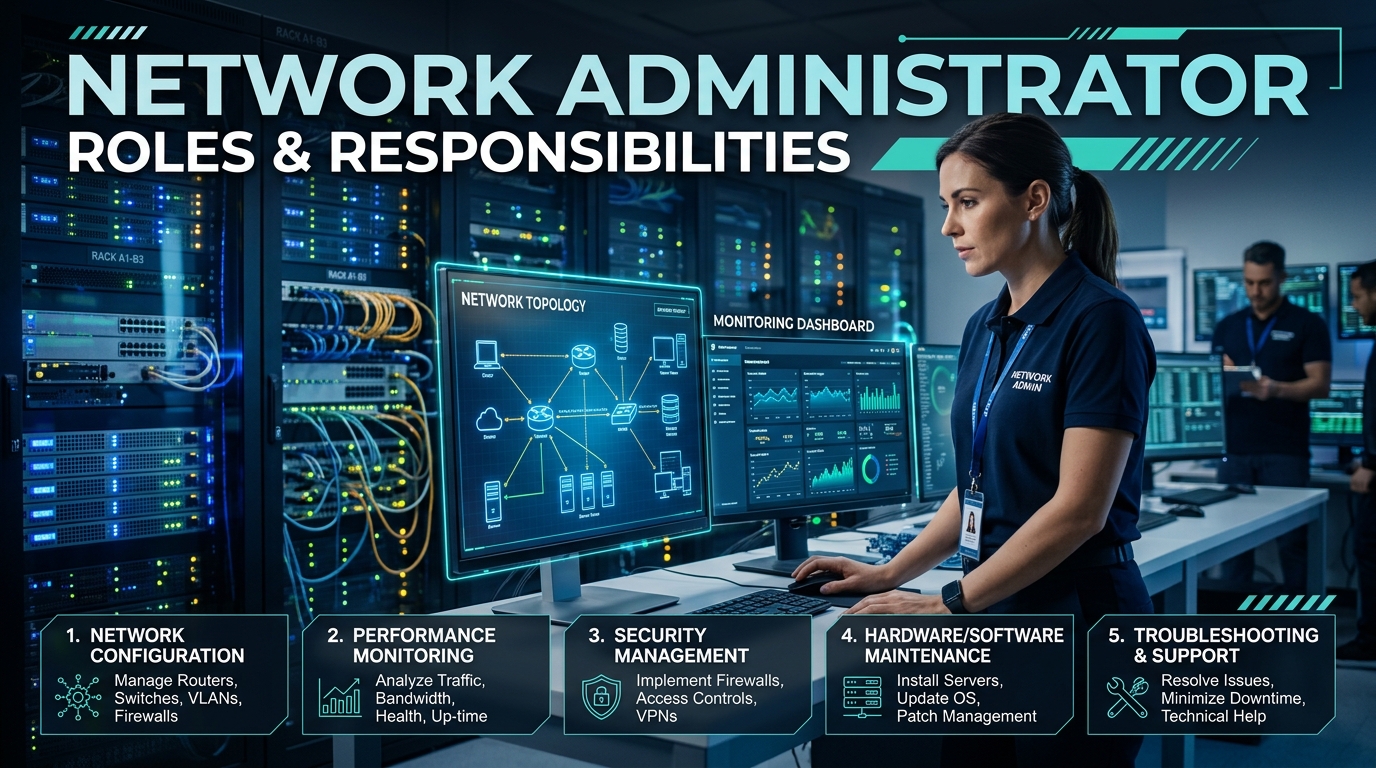
The daily tasks of a modern network administrator fall across five critical pillars:
1. Hardware Deployment & Device Configuration
Racking, cabling, configuring, and upgrading physical and virtual network hardware including:
- Managed Layer 2/3 Switches: Setting up port security, 802.1Q trunking, VLAN segmentation, and Spanning Tree Protocol (STP) to prevent switching loops.
- Enterprise Routers: Configuring routing protocols such as OSPF, EIGRP, and BGP, along with Static Routes and Network Address Translation (NAT/PAT).
- Wireless Access Points & WLCs: Deploying enterprise Wi-Fi controllers, managing SSIDs, and optimizing RF signal coverage.
2. Traffic Monitoring & Performance Optimization
Ensuring enterprise bandwidth is utilized efficiently and bottleneck-free:
- Monitoring network health with SNMP tools like PRTG, SolarWinds, Nagios, and Zabbix.
- Implementing Quality of Service (QoS) policies to prioritize latency-sensitive traffic such as VoIP telephony and video conferencing over bulk downloads.
- Diagnosing jitter, packet loss, and high round-trip times (RTT) using packet capture tools like Wireshark.
3. Network Security & Perimeter Defense
Collaborating with cybersecurity teams to fortify network boundaries:
- Configuring Next-Generation Firewalls (NGFW) from Cisco, Fortinet, and Palo Alto Networks.
- Establishing secure site-to-site IPsec VPN tunnels connecting branch offices to corporate headquarters and SSL/TLS remote-access client VPNs for telecommuters.
- Creating granular Access Control Lists (ACLs) and implementing 802.1X network access control (NAC).
4. Disaster Recovery, Backups & High Availability
Guaranteeing business continuity in the event of hardware failure:
- Automating daily router and switch configuration backups using TFTP/SFTP scripts.
- Configuring first-hop redundancy protocols (HSRP / VRRP) for dual-router failover.
- Participating in disaster recovery drills and WAN link failover testing (e.g., primary fiber to secondary 5G/satellite link).
5. User Management & Core Network Services
Overseeing essential protocols that allow client computers to communicate seamlessly:
- Administering DHCP server pools, static IP reservations, and lease durations.
- Configuring internal DNS servers, forward/reverse lookup zones, and DNS forwarders.
- Managing user directory groups and authentication protocols via RADIUS and TACACS+.
Network Administrator vs Network Engineer vs Systems Administrator
| Role | Primary Focus Area | Core Tools Used | Typical India Salary (3–5 Yrs) |
|---|---|---|---|
| Network Administrator | Day-to-day operation, configuration, monitoring, and uptime of existing networks | Cisco IOS, Wireshark, SolarWinds, FortiOS, PRTG | Rs 5,50,000 – Rs 9,50,000 |
| Network Engineer / Architect | Designing, architecting, and deploying large-scale enterprise/datacenter networks | BGP, SD-WAN, Cisco DNA Center, Python, Ansible | Rs 8,00,000 – Rs 16,00,000 |
| Systems Administrator | Managing servers, operating systems, user accounts, and endpoint fleets | Windows Server, Active Directory, Linux, VMware, PowerShell | Rs 5,00,000 – Rs 9,00,000 |
Essential Skills Required for Network Administrators
- IP Subnetting & Addressing: Calculating network IDs, broadcast addresses, and variable-length subnet masks (VLSM) rapidly in IPv4 and IPv6.
- Cisco Command-Line Interface (CLI): Memorizing syntax for interface provisioning, VLAN creation, routing configuration, and running diagnostic show commands (
show ip route,show ip interface brief). - Network Automation (Python & Ansible): Modern administrators use scripts to push configuration changes across 200 switches simultaneously rather than logging in one by one.
- Troubleshooting Methodology: Following structured OSI layer troubleshooting—checking physical cable continuity (Layer 1) before debugging DNS resolution (Layer 7).
Top Networking Certifications for Career Growth
Certifications remain the most universally accepted proof of competence in network administration:
CompTIA Network+ (N10-009)
Ideal for absolute beginners building foundational knowledge across hardware, cabling, and topology basics.
Cisco CCNA (200-301)
The most demanded certification in Indian IT job listings. Covers enterprise routing, switching, wireless, and automation.
Cisco CCNP Enterprise
Advanced routing architectures, SD-WAN, and enterprise wireless engineering for professionals with 3+ years experience.
Network Administrator Salary in India (2026 Benchmarks)
| Experience Level | Designations | Annual CTC Range (INR) |
|---|---|---|
| Freshers / Trainee (0–2 Yrs) | Junior Network Admin, NOC Analyst Tier-1, Network Support Trainee | Rs 3,20,000 – Rs 5,50,000 |
| Mid-Level (3–6 Yrs) | Network Administrator, Network Operations Specialist, NOC Tier-2 | Rs 6,00,000 – Rs 11,00,000 |
| Senior / Lead (7–10+ Yrs) | Senior Network Admin, Infrastructure Lead, Network Operations Manager | Rs 12,00,000 – Rs 22,00,000+ |
Master Real Network Hardware at Aptech Learning Gurugram
Simulators like Cisco Packet Tracer are helpful for beginners, but employers require candidates who have plugged in real console cables, crimped Cat6 ethernet cords, configured physical modular routers, and troubleshot live hardware switch stacks.
At EduQuest Aptech Learning, our networking lab in Gurugram features fully equipped equipment racks with Cisco Catalyst switches, Cisco ISR routers, hardware firewalls, and server racks.
📍 Visit the Hardware & Networking Lab in Gurugram
Located at Galleria Market, DLF Phase-IV, Sector 28, Gurugram, EduQuest Aptech Learning provides comprehensive hands-on training for CCNA, Network+, and advanced enterprise networking.
Frequently Asked Questions (FAQ)
What educational qualification is needed to become a network administrator?
Most employers accept graduates with BCA, B.Sc Computer Science, B.Tech, or 3-year Poly-technic diplomas in Electronics/Computer Engineering. What matters most is demonstrable CLI configuration skill and certifications like CCNA.
Can a desktop support technician transition to network administrator?
Yes, this is one of the most common career paths in Indian IT. Desktop support professionals already understand basic IP settings; by clearing the CCNA exam and learning switch/router configuration, they can transition directly into Network Operations Center (NOC) roles.
Do network administrators work on weekends or nights?
In 24/7 organizations like banks, telecom companies, and global MNC NOCs, entry-level administrators often work in rotational shifts with attractive shift allowances. Major network upgrades are scheduled during scheduled weekend maintenance windows.