

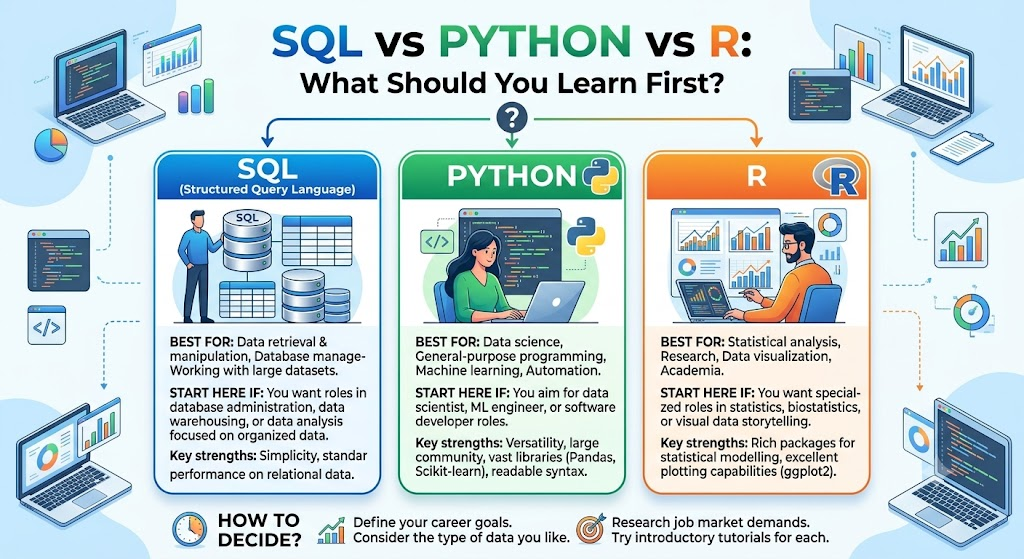
If you've started exploring a career in data — data analyst, data scientist, business analyst, or even product management — you've probably hit the same wall every beginner hits: should I learn SQL, Python, or R first?
Every roadmap on the internet gives a different answer. Some say "Python is all you need." Others swear by SQL as the true foundation. Statisticians will tell you nothing beats R. The honest answer is: it depends on the job you want, and in this guide, we'll break down exactly how to decide — with no fluff.
Download Free SQL vs Python vs R Decision Guide (PDF)
Get instant access to side-by-side comparison tables, 3-step learning roadmap checklists, beginner career pathways, and salary benchmarks.
Quick Answer (TL;DR)
- Learn SQL first if you want to become job-ready fastest, especially for data analyst or business analyst roles.
- Learn Python next if you want to move into data science, automation, machine learning, or a broader tech career.
- Learn R only if your path is academic research, biostatistics, clinical trials, or a specific R-heavy team/industry.
For most beginners in India targeting analytics or data science careers, the ideal order is SQL → Python → (R, if needed later).
What Each Language Is Actually Used For
1. SQL — The Language of Data Itself
SQL (Structured Query Language) is how you talk to databases. Every company that stores data — which is every company — uses SQL somewhere in its stack. It's not really a "programming language" in the traditional sense; it's a query language built to pull, filter, join, and aggregate data.
- Used for: extracting data from company databases, building reports, answering business questions, powering dashboards (Tableau, Power BI, Looker all sit on top of SQL).
- Where you'll see it: virtually every data analyst, business analyst, and data engineer job description.
2. Python — The General-Purpose Workhorse
Python is a full programming language, which means it can do almost anything: data analysis (pandas), visualization (matplotlib, seaborn), machine learning (scikit-learn, TensorFlow, PyTorch), automation, web scraping, and even building full applications.
- Used for: data science, machine learning, AI, automation scripts, backend development, and increasingly, general business analytics too.
- Where you'll see it: data scientist, ML engineer, data analyst (advanced), automation, and product analytics roles.
3. R — The Statistician's Toolkit
R was built by statisticians, for statistics. It remains extremely strong in academic research, biostatistics, epidemiology, and any field where rigorous statistical modeling and publication-quality visualization matter.
- Used for: academic research, clinical/medical data analysis, econometrics, specialized statistical modeling.
- Where you'll see it: research roles, pharma/biotech, academia, and some legacy analytics teams (especially in finance and government).
Side-by-Side Comparison
| Factor | SQL | Python | R |
|---|---|---|---|
| Learning curve | Easiest | Moderate | Moderate-Hard |
| Time to job-ready | 3-6 weeks | 2-4 months | 2-4 months |
| Primary use | Querying data | Data science, ML, automation | Statistics, research |
| Job demand (India) | Very high | Very high | Niche but strong in specific sectors |
| Career paths | Data/Business Analyst, BI | Data Scientist, ML Engineer, Analyst | Research Analyst, Biostatistician |
| Community & resources | Huge | Largest | Strong, academic-focused |
| Do you need it eventually? | Yes, almost always | Yes, for most data roles | Only if your domain needs it |
How to Decide: 4 Questions to Ask Yourself
1. What's my target job title?
If you're aiming for "Data Analyst" or "Business Analyst," SQL will get you interview-ready the fastest — most entry-level screening rounds test SQL directly. If your goal is "Data Scientist" or "ML Engineer," you'll need Python regardless, but SQL will still show up constantly for pulling data.
2. How much time do I have before I need a job?
SQL has the shortest path to a usable, resume-worthy skill. If you need to be interview-ready in 4-6 weeks, start there. Python and R both need a longer runway to reach a comparable comfort level.
3. What industry am I targeting?
Tech, e-commerce, fintech, product companies → SQL + Python dominate. Pharma, clinical research, academia, government statistics → R still holds significant ground.
4. Am I choosing between "coding" at all, or between R and Python specifically?
If you already know you want to code and are only torn between Python and R, choose Python unless your specific field (biostatistics, epidemiology, academic research) leans R. Python's broader ecosystem and job market make it the safer default for most careers.
The Recommended Learning Order
SQL (3–6 Weeks) — Master the Data Layer
Learn SELECT, WHERE, GROUP BY, JOINs, subqueries, and window functions. This alone qualifies you for many entry-level analyst roles and technical screening interviews.
Python for Data (6–10 Weeks) — Analytics & Modeling
Learn Python fundamentals, then pandas for data manipulation, matplotlib/seaborn for visualization, and basic applied statistics. This opens the door to data science and advanced analyst roles.
Specialize (ML vs Research/Stats)
If your path goes toward machine learning, add scikit-learn and deepen your math/stats. If your path goes toward academic research or a specific R-based industry, pick up R at this stage — it will be much easier once you understand SQL and Python fundamentals.
Common Myths, Busted
- "You have to pick one and master it." False. Most working data professionals use SQL daily and Python (or R) for deeper analysis. They're complementary, not competing.
- "R is dying, don't bother." Not true for specific fields — R remains dominant in biostatistics, clinical research, and academic publishing. It's not the right default for most beginners, but it isn't obsolete.
- "Python is only for data scientists." Also false — Python is increasingly used by data analysts too, especially for automating repetitive Excel/reporting work and connecting to REST APIs.
Recommended Industry-Aligned Training Tracks
Aptech Learning Gurugram provides structured classroom and hybrid programs with live project coaching and placement drives:
Smart Pro Data Science Track →
Comprehensive professional track covering SQL, Python, Applied Statistics, Machine Learning & AI.
Data Roles Comparison Guide →
Compare salary, day-to-day responsibilities, and required tools for Analyst, Scientist & Engineer roles.
Data Science Portfolio Guide →
Learn how to build a portfolio with 3-6 real GitHub projects to get hired without prior job experience.
Frequently Asked Questions (FAQs)
Q1. Should a complete beginner start with SQL or Python?
Start with SQL. It has a gentler learning curve, faster payoff, and is a near-universal requirement across every data role, making it the most efficient first step.
Q2. Can I get a data analyst job knowing only SQL?
Yes, especially at the entry level — many data analyst roles are SQL-heavy with Excel and a BI tool (Power BI/Tableau) rounding out the skill set. Python is a strong addition but not always mandatory to get started.
Q3. Is R still worth learning in 2026?
Yes, if you're targeting research, biostatistics, clinical data, or econometrics-heavy roles. For general data science and analytics careers, Python is the more versatile choice.
Q4. How long does it take to become job-ready?
With focused, structured practice: SQL in 3-6 weeks, Python (for data roles) in 2-4 months on top of that. Timelines vary based on prior coding exposure and hours invested per week.
Download Free SQL vs Python vs R Decision Guide (PDF)
Keep this printable decision matrix, career roadmaps, and tool stack checklist handy while planning your learning path.
Final Word
There's no universally "correct" first language — only the one that matches your target role and timeline. For most students and career-switchers building a data career from scratch, the sequence SQL → Python → specialize (R if needed) offers the fastest path to job-readiness without wasted effort.
📞 Need Help Mapping Out Your Data Career?
Talk to EduQuest's academic counselors at +91 99580 41888 or visit our center at Galleria, DLF Phase-IV, Gurugram. We'll help you build a personalized learning roadmap aligned with your goals and schedule.