
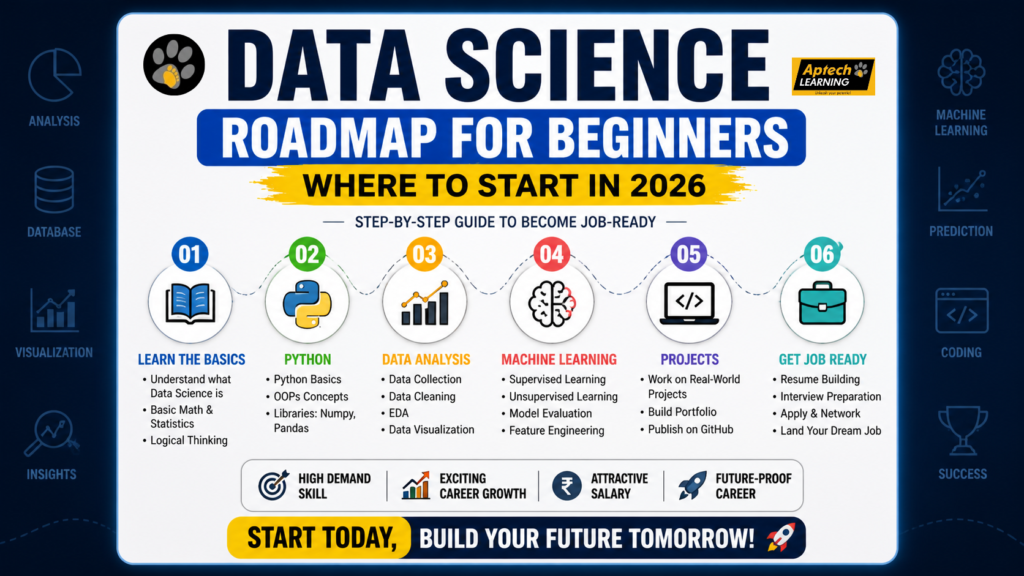
Data Science Roadmap for Beginners:
Where to Start in 2026
Clear, step-by-step, zero fluff. Go from absolute zero to job-ready in 8–12 months.
😤 Confused About Where to Start Data Science?
If you have Googled "how to start data science from scratch" and ended up more confused than when you started — you are not alone. Dozens of tools, hundreds of courses, and zero clarity. Python or R? Machine learning or data analysis first? Self-learn or join a course?
This guide cuts through all the noise. Here is a clear, step-by-step data science roadmap for beginners in 2026 — designed for people who are starting from absolute zero, with realistic timelines and zero fluff.
⚡ Quick Answer: How to Start Data Science in 2026
To start data science in 2026, follow these steps: begin with Python and basic statistics, then move to data analysis and SQL, followed by machine learning, and finally build real-world projects to become job-ready. A dedicated learner can go from beginner to job-ready in 8–12 months.
🗺️ Data Science Roadmap 2026 — Step-by-Step Flow
Here is the complete beginner roadmap for data science visualised as a simple flow. Each stage builds on the previous — do NOT skip steps.
Stats
Analysis
Learning
Ready
📌 Step-by-Step Data Science Roadmap for Beginners (2026 Edition)
Below is the complete beginner roadmap for data science broken into six clear stages. Follow them in order for best results.
Every data science roadmap step by step begins here. You do not need to be a math genius — you just need the fundamentals:
- Basic Statistics: mean, median, mode, standard deviation
- Probability: concepts of likelihood, distributions
- Linear Algebra basics: vectors and matrices (light exposure)
- Logical thinking: how to break a problem into smaller parts
Python is the #1 language for data science in 2026. It is beginner-friendly, versatile, and has the richest ecosystem of data libraries. Here is what to learn:
- Python basics: variables, loops, functions, conditionals
- File handling and data types
- Pandas: data manipulation and cleaning
- NumPy: numerical computing
- Matplotlib / Seaborn: data visualisation
🎓 Explore Information Technology Programs at Aptech Learning →
This is where you begin working with real data — cleaning it, analysing it, and drawing insights. Key skills:
- Excel: pivot tables, VLOOKUP, basic dashboards
- SQL: querying databases (SELECT, JOIN, GROUP BY)
- Data cleaning: handling missing values, outliers
- Visualisation tools: Power BI / Tableau for reporting
Machine learning (ML) is the core of data science. Do not rush here — master the basics before going deep into deep learning:
- Supervised Learning: Regression (predict numbers) and Classification (predict categories)
- Unsupervised Learning: Clustering (K-Means)
- Model building with Scikit-Learn
- Evaluation metrics: accuracy, precision, recall, RMSE
- Overfitting vs underfitting and how to fix them
🎓 Explore Full Program Overview at Aptech Learning →
Projects are what separate job-ready candidates from tutorial watchers. Here are beginner-friendly project ideas for your portfolio:
- Movie recommendation system (collaborative filtering)
- House price prediction (regression)
- Customer churn analysis (classification + SQL)
- COVID-19 data dashboard (visualisation)
- Sentiment analysis on product reviews (NLP intro)
Upload every project to GitHub with a clear README. Recruiters look at your GitHub profile before your resume — treat it like your digital resume.
The final phase of your data science roadmap is getting hired. Here is how to prepare:
- Build a clean GitHub portfolio with 3–5 projects
- Write a data-focused resume: highlight tools, metrics, and impact
- Prepare for technical interviews: SQL, Python, statistics, case studies
- Practice on platforms like LeetCode, HackerRank, and StrataScratch
- Network on LinkedIn with data scientists and recruiters
⏳ Realistic Timeline to Become a Data Scientist in 2026
One of the most common questions from beginners is: "How long does it take to become a data scientist?" Here is a realistic, honest answer:
| Stage | Estimated Time |
|---|---|
| Step 1: Math & Statistics Basics | 1–2 months |
| Step 2: Python for Data Science | 1–2 months |
| Step 3: Data Analysis & SQL | 1–2 months |
| Step 4: Machine Learning Fundamentals | 2–3 months |
| Step 5: Projects & Portfolio Building | 2–3 months |
| Step 6: Job Preparation & Interviews | 1–2 months |
| Total (Consistent Daily Learning) | 8–12 months |
🧰 Tools You Need for Data Science in 2026
You do not need to master every tool at once. Here is a priority-ordered list of tools used in data science that beginners should learn:
❌ Common Mistakes Beginners Make (And How to Avoid Them)
These mistakes are what keep beginners stuck in "tutorial hell" for months. Avoid them from day one:
🔍 Data Analyst vs Data Scientist — What is the Difference?
Many beginners confuse these two roles. Here is a clear breakdown to help you pick the right path:
🤔 Is Data Science Still Worth It in 2026?
With AI tools like ChatGPT automating tasks, many beginners worry: "Is the data science roadmap still relevant?" The honest answer is yes — and here is why:
💡 Self-Learning vs Joining a Data Science Course — Which is Better?
This is the most debated question in the beginner community. Here is an honest comparison:
| Factor | Self-Learning (Free) |
|---|---|
| Cost | Free / very low |
| Speed | Slow (12–18 months) |
| Guidance | None — you figure it out |
| Projects | You design them yourself |
| Placement | You apply on your own |
| Discipline | Requires extreme self-motivation |
🎯 Ready to Start Your Data Science Journey?
Stop overthinking and start learning. Aptech Learning India offers structured, industry-aligned data science training with placement support — designed specifically for beginners in 2026.
❓ FAQ — Data Science Roadmap for Beginners
Answers to the most common questions from beginner data science learners.
📚 Related Resources from Aptech Learning India
Explore more resources to accelerate your learning journey:
🔗 Official References & Authority Sources
This blog references trusted external sources to give you the most accurate information:
🚀 Your Data Science Journey Starts Today
The best time to start was yesterday. The second-best time is right now. Take the first step — book a free counselling session with our expert today.