

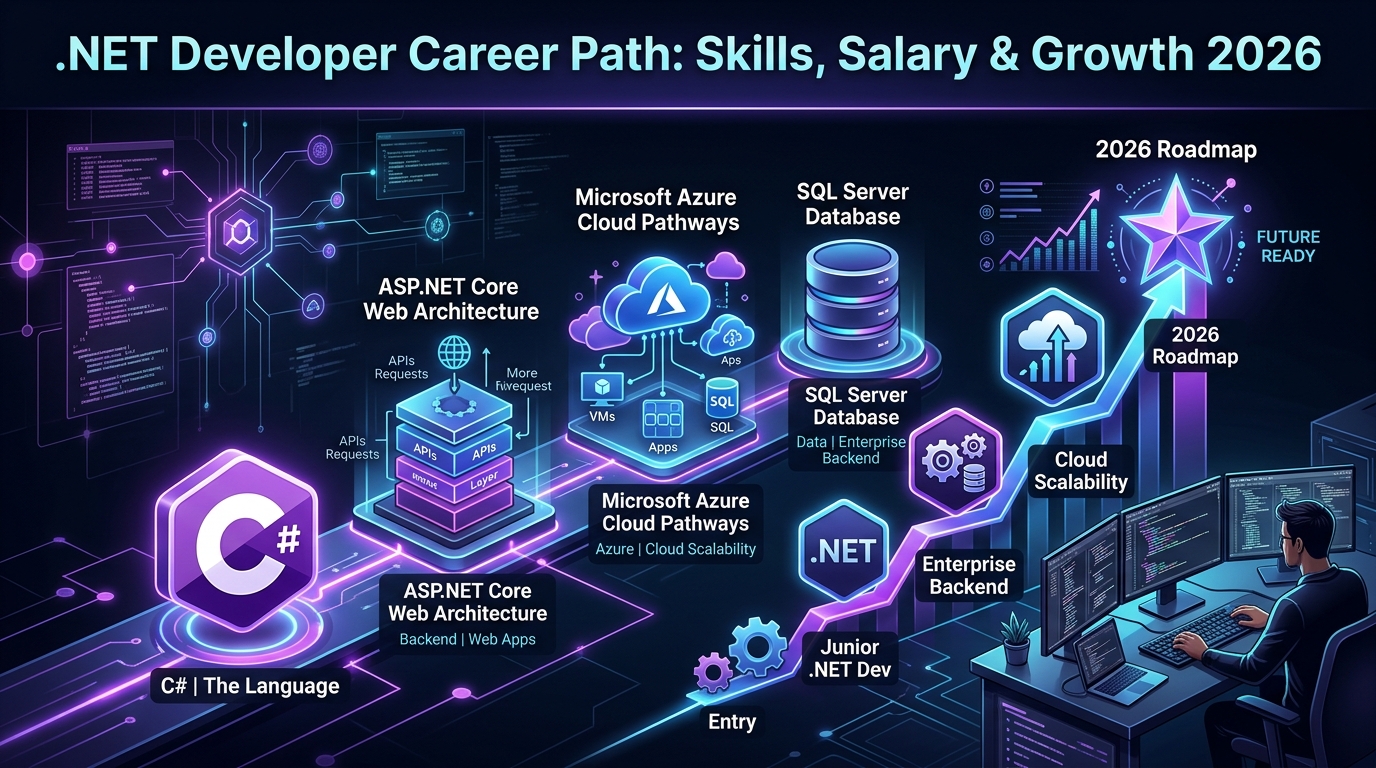
A career as a .NET developer represents one of the most stable, lucrative, and resilient engineering paths in the global technology landscape. For over two decades, Microsoft's .NET ecosystem has served as the trusted engine behind enterprise banking systems, healthcare software, government portals, high-throughput cloud services, and mission-critical corporate architectures.
Modern .NET is not the legacy, Windows-only platform of the past. Today, .NET is a lightning-fast, open-source, cross-platform powerhouse running seamlessly on Linux, macOS, and Windows. Coupled with C# — consistently ranked among the world's most elegant, productive, and beloved programming languages — and ASP.NET Core, the modern .NET ecosystem enables developers to architect everything from high-performance microservices and cloud-native REST APIs to full-stack web applications integrated with React and Angular.
However, simply learning basic C# syntax is no longer enough to secure a high-paying role in 2026. Employers look for well-rounded engineers who command database design, secure RESTful APIs, modern ORMs like Entity Framework Core, automated testing, containerization, and cloud deployment.
In this comprehensive guide, we map out the complete .NET developer career path: core responsibilities, an 11-step beginner-to-advanced roadmap, production skills checklist, real-world salary factors in India, enterprise career levels, and actionable advice to become genuinely job-ready.
🎁 Download Free Complete .NET Developer Roadmap 2026 — PDF Checklist
Want to build a high-growth career as a .NET developer? Download our free 2026 Roadmap PDF and track every skill from C# fundamentals to enterprise cloud architecture. Includes 11 pages of skill checklists, SQL/EF Core blueprints, 10 portfolio project ideas, and interview preparation guides.
What Is a .NET Developer?
A .NET developer is a software engineer who builds, deploys, and maintains applications utilizing Microsoft's .NET technology stack. While historically associated with desktop Windows programs, the modern .NET developer primarily designs cloud-first web applications, distributed APIs, and enterprise systems.
Depending on their specialization and company tier, a .NET developer may architect:
- Cloud-Native Web Applications: High-traffic portals and SaaS platforms built with ASP.NET Core MVC or Blazor.
- High-Performance REST & gRPC APIs: Microservices handling tens of thousands of requests per second for web and mobile frontends.
- Enterprise Backend Systems: Secure core transaction engines for commercial banks, insurance providers, and global supply chain networks.
- Full-Stack Applications: Combining an ASP.NET Core backend with modern client-side frameworks like React or Angular.
- Distributed Cloud Services: Serverless workflows, background workers, and message-driven queues deployed on Microsoft Azure or AWS.
In modern production environments, a typical full-stack .NET architecture looks like this:
↓ HTTPS / JSON (RESTful or gRPC Requests)
WEB API TIER: ASP.NET Core (Routing, Middleware, Controllers, Auth)
↓ Dependency Injection (Domain Services & Business Logic)
DATA ACCESS TIER: C# + Entity Framework Core (ORM)
↓ Optimized SQL Queries
PERSISTENCE TIER: Microsoft SQL Server / PostgreSQL / Redis Cache
↓ Hosted On
CLOUD PLATFORM: Microsoft Azure / Docker Containers / Kubernetes
.NET Developer Career Path at a Glance
To avoid feeling overwhelmed by Microsoft's vast product ecosystem, here is the proven, step-by-step linear roadmap to follow:
What Does a .NET Developer Do Day-to-Day?
A .NET developer's daily activities combine writing clean, modular code, collaborating across engineering teams, and optimizing production services. Typical day-to-day responsibilities include:
- Architecting & Maintaining RESTful APIs: Designing endpoints with clean request/response contracts for mobile apps and web frontends.
- Writing Business Logic & Domain Workflows: Coding order fulfillment, payroll computations, discount rule validations, and transaction isolation.
- Database Schema & Query Optimization: Designing tables, writing indexes, executing database migrations with EF Core, and diagnosing slow SQL execution plans.
- Implementing Authentication & Authorization: Integrating OAuth2/OpenID Connect, Azure Active Directory, JWT bearer tokens, and granular permission claims.
- Automated Testing: Writing unit tests with xUnit or NUnit, mocking service dependencies, and running integration test pipelines.
- Code Reviews & Collaboration: Reviewing pull requests on GitHub or Azure DevOps, adhering to clean architecture patterns (CQRS, Repository pattern).
- Troubleshooting & Performance Profiling: Analyzing memory leaks, async deadlocks, and optimizing garbage collection using tools like dotTrace or Visual Studio Diagnostics.
Step 1: Learn C# (The Language Foundation)
C# (C-Sharp) is the foundational programming language of the .NET universe. It is an elegant, strongly typed, object-oriented, and component-oriented language developed under the leadership of Anders Hejlsberg at Microsoft.
Break your C# journey into three progressive stages:
- Stage 1 — Core Syntax: Variables, primitive types (
int,string,bool,decimalfor financial math), conditionals (if/else, switch pattern matching), loops, collections (List<T>,Dictionary<TKey, TValue>), and robust exception handling (try-catch-finally). - Stage 2 — Object-Oriented Principles: Classes, objects, constructors, encapsulation, inheritance, polymorphism, abstract classes, and interfaces. Understanding how interfaces decouple code is vital for enterprise dependency injection.
- Stage 3 — Advanced Modern C#:
- LINQ (Language Integrated Query): Querying and transforming in-memory collections and database rows using declarative syntax (
Select,Where,GroupBy,OrderBy). - Asynchronous Programming (
async/await): Writing non-blocking code usingTaskandTask<T>to keep servers responsive under massive concurrency. - Generics, Delegates, and Events: Writing type-safe, reusable algorithms.
- Modern C# 12 & 13 Features: Records for immutable data transfer, primary constructors, pattern matching, and nullable reference types.
- LINQ (Language Integrated Query): Querying and transforming in-memory collections and database rows using declarative syntax (
Beginner Practice Projects for C#: Build a console-based Banking Ledger with deposit/withdrawal transactions, a Student Grading System calculating GPAs, and an Inventory Management Tracker storing records to JSON.
Step 2: Learn .NET Platform Fundamentals
A common point of confusion for beginners is distinguishing between C#, .NET, and ASP.NET Core. Let's make this crystal clear:
C# (The Language)
The programming language you write syntax in — variables, loops, classes, and logic.
.NET (The Runtime & Ecosystem)
The execution platform: Common Language Runtime (CLR), garbage collection, base class libraries, and compiler.
ASP.NET Core (The Framework)
The specialized web framework built on top of .NET for routing HTTP requests, controllers, and APIs.
Key platform concepts you must master:
- The .NET CLI: Mastering daily terminal commands:
dotnet new,dotnet build,dotnet run,dotnet test, anddotnet publish. - NuGet Package Manager: Installing and managing third-party open-source libraries via
dotnet add package. - Dependency Injection (DI): Mastering the built-in IoC container:
AddTransient(new instance per request),AddScoped(one instance per HTTP request lifecycle), andAddSingleton(single global instance). - Configuration & Options Pattern: Reading strongly typed settings from
appsettings.jsonand environment variables across Development, Staging, and Production.
Step 3: Learn ASP.NET Core (Web APIs & Applications)
ASP.NET Core is the crown jewel of the modern .NET ecosystem. Consistently topping the independent TechEmpower benchmarks for raw request-handling speed, it outperforms rival runtimes like Node.js, Spring Boot, and Django.
Topics to focus on in ASP.NET Core:
- Minimal APIs vs Controller-Based APIs: Minimal APIs provide lightweight, single-file endpoints ideal for microservices, while Controller-based APIs provide structured organization for large enterprise applications.
- The Middleware Pipeline: Understanding how HTTP requests travel through a sequence of delegates (Exception Handling → HTTPS Redirection → Routing → CORS → Authentication → Authorization → Endpoint execution).
- Model Binding & Validation: Automatically mapping JSON request bodies to C# DTOs (Data Transfer Objects) and validating constraints with
[Required],[EmailAddress], or FluentValidation. - Centralized Global Error Handling: Returning standardized RFC 7807 ProblemDetails error responses to frontend clients.
Step 4: Learn SQL and Databases (SQL Server & PostgreSQL)
Backend systems live and die by their data layer. A .NET developer who knows only C# but cannot write optimized SQL will struggle in enterprise environments.
Master these database essentials:
- Core SQL Mastery: Writing complex
SELECTqueries withINNER JOIN,LEFT JOIN,GROUP BY,HAVING, aggregate functions, and nested subqueries. - Relational Schema Design: Primary keys, foreign keys, cascade delete rules, unique constraints, and normalization (1NF, 2NF, 3NF).
- Indexing & Performance: Clustered vs non-clustered indexes, preventing full table scans, and reading execution plans.
- Transactions & ACID Guarantees:
BEGIN TRANSACTION,COMMIT, andROLLBACKfor multi-step financial operations. - Primary Database: Start with Microsoft SQL Server (using SQL Server Management Studio or Azure Data Studio), then explore PostgreSQL.
Step 5: Learn REST APIs (Contract-Driven Architecture)
Modern applications are decoupled: frontend user interfaces (React, mobile apps) talk to the backend through RESTful HTTP APIs. You must understand how to design predictable, scalable endpoints:
- Standard HTTP Verbs:
GET(fetch),POST(create),PUT(full replacement),PATCH(partial update), andDELETE(remove). - Standard HTTP Status Codes:
200 OK,201 Created,204 No Content,400 Bad Request,401 Unauthorized,403 Forbidden,404 Not Found,409 Conflict,500 Server Error. - Interactive API Documentation: Configuring Swagger / OpenAPI (Swashbuckle) so frontend developers can test endpoints directly in the browser.
- Pagination, Filtering & Sorting: Never return 50,000 records at once; implement cursor or offset pagination (
pageNumberandpageSize).
Step 6: Learn Frontend Technologies (Full-Stack Advantage)
While you can specialize purely as a backend .NET engineer, gaining full-stack capability dramatically multiplies your career versatility and hiring appeal.
HTML5 & CSS3
Semantic document structure, CSS Flexbox and Grid, mobile responsiveness, and utility styling with Tailwind CSS.
JavaScript & TypeScript
DOM manipulation, Fetch API, async/await, and static typing with TypeScript (which feels remarkably natural to C# developers).
React or Angular
Pick one frontend framework. In enterprise corporate IT, .NET + Angular is immensely popular; in modern startups and product firms, .NET + React dominates.
Step 7: Learn Entity Framework Core (EF Core)
Entity Framework Core is Microsoft's official Object-Relational Mapper (ORM). It allows developers to query and manipulate database records using strongly typed C# classes and LINQ expressions, completely eliminating raw SQL string concatenation.
Master these EF Core pillars:
DbContext&DbSet<T>: Managing connection pools, unit-of-work patterns, and entity collections.- Database Migrations: Using
dotnet ef migrations addanddotnet ef database updatefor reproducible, version-controlled schema evolution. - Entity Relationships: Configuring One-to-Many and Many-to-Many relationships via Fluent API or Data Annotations.
- Performance Optimization: Using
.AsNoTracking()for read-only queries, eager loading with.Include()to prevent N+1 query problems, and compiled models.
⚠️ Crucial Senior Engineer Advice: Never use an ORM as an excuse to avoid learning SQL. In technical interviews and high-scale production systems, you must know what exact SQL queries EF Core generates under the hood.
Step 8: Learn Authentication and Web Security
Securing enterprise applications is non-negotiable. Modern .NET provides powerful, production-ready security libraries:
- ASP.NET Core Identity: Built-in membership management handling user registration, password hashing (PBKDF2), two-factor authentication (2FA), and lockout policies.
- JWT (JSON Web Tokens): Generating signed bearer tokens for stateless REST API authorization with customizable claims and expiration.
- Role-Based & Policy-Based Authorization: Using attributes like
[Authorize(Roles = "Admin")]or custom policy requirements for granular access control. - Common Web Vulnerability Defense: Protecting against Cross-Site Scripting (XSS), Cross-Site Request Forgery (CSRF), SQL Injection, and properly configuring Cross-Origin Resource Sharing (CORS).
Step 9: Learn Git & GitHub (Version Control)
From day one, maintain your projects on GitHub or Azure Repos. Practice branch-based workflows (feature branches, pull requests, code reviews, and resolving merge conflicts). Maintain an attractive GitHub profile with detailed README.md documentation explaining architecture, database setup, and live demo links.
Step 10: Learn Testing and Debugging
Enterprise employers value developers who write reliable, maintainable code. Master the software testing triangle:
- Unit Testing with xUnit: Writing isolated tests verifying individual business logic methods following the Arrange-Act-Assert pattern.
- Mocking with Moq: Mocking repository interfaces, external payment APIs, and database calls to test business services in total isolation.
- Integration Testing: Utilizing
WebApplicationFactoryto spin up in-memory test servers and verify full end-to-end API HTTP requests. - Structured Logging: Integrating Serilog to emit structured JSON logs to sinks like Seq, Application Insights, or ElasticSearch.
Step 11: Learn Cloud & Deployment (Microsoft Azure)
Because .NET is a Microsoft technology, its synergy with Microsoft Azure is unrivaled. Understanding core cloud concepts elevates your market value significantly:
- Docker Containerization: Authoring multi-stage
Dockerfilesto build compact, production-ready Linux containers running .NET apps. - Azure App Services & Container Apps: Hosting scalable web APIs with zero server management.
- Azure SQL Database: Provisioning and connecting managed cloud databases.
- CI/CD Pipelines: Writing automated GitHub Actions or Azure DevOps pipelines to build, test, and deploy code on every Git push.
.NET Developer Skills Checklist
| Domain | Core Required Skills | Enterprise Differentiators |
|---|---|---|
| Programming | C#, OOP, LINQ, Async/Await, Generics | C# 12/13 Features, Memory/Span<T>, Reflection |
| Backend | .NET 8/9, ASP.NET Core, REST APIs, Middleware | gRPC, SignalR (WebSockets), MediatR (CQRS) |
| Data Access | SQL Server, Entity Framework Core, Migrations | Dapper (Micro-ORM), Redis Caching, PostgreSQL |
| Security | JWT, ASP.NET Identity, HTTPS, CORS, Password Hashing | OAuth2, OpenID Connect, Azure Active Directory |
| Frontend | HTML5, CSS3, JavaScript, REST API integration | React.js, Angular, TypeScript, Tailwind CSS |
| DevOps & Cloud | Git, GitHub, Docker basics, Environment configs | Azure App Services, CI/CD Pipelines, Kubernetes |
| Testing | xUnit or NUnit, Visual Studio Debugger | Moq, Integration Tests, FluentAssertions |
.NET Developer Career Levels & Progression
A career in the .NET ecosystem offers clear, structured advancement opportunities across enterprise corporate ladders:
1. Junior .NET Developer (0–2 Years)
Focuses on writing clean C# code, fixing bugs, implementing simple REST endpoints, creating EF Core migrations, and learning team collaboration under senior guidance.
2. Mid-Level .NET Developer (2–5 Years)
Independently designs end-to-end API features, optimizes complex database queries, sets up authentication flows, writes unit test suites, and mentors junior devs.
3. Senior .NET Developer (5–8 Years)
Architects scalable microservices, leads database schema design, enforces code quality standards, designs CI/CD pipelines, and manages cloud infrastructure.
4. Lead Developer / Solutions Architect (8+ Years)
Defines enterprise architecture, evaluates technical risk, oversees multi-team engineering roadmaps, and aligns technology choices with business strategy.
.NET Developer Salary in India (2026 Reality)
Compensation in India's software engineering market varies significantly based on practical skill depth, company tier, and geographic location rather than a single fixed number. Here is a realistic overview across Indian tech hubs (Gurugram, Bengaluru, Hyderabad, Pune, Noida) based on 2025–2026 hiring datasets (AmbitionBox, Glassdoor, and LinkedIn Talent Insights):
| Experience Level | Career Stage | Typical Annual Compensation (India) |
|---|---|---|
| 0–1 Year | Junior / Fresher Developer | ₹3.5 LPA – ₹6.5 LPA |
| 1–3 Years | Software Engineer | ₹6.5 LPA – ₹11.0 LPA |
| 3–5 Years | Mid-Level / Senior Engineer | ₹11.0 LPA – ₹18.0 LPA |
| 5–8 Years | Senior Developer / Tech Lead | ₹18.0 LPA – ₹30.0 LPA |
| 8+ Years | Solutions Architect / Principal Engineer | ₹30.0 LPA – ₹50.0+ LPA |
*Note: Top product firms, fintech enterprises, and global capability centers (GCCs) in Gurugram Cyber City and Bengaluru regularly pay in the upper quartile of these ranges.
What Directly Influences a .NET Developer's Salary?
- 1. System Design & Architectural Mastery: Knowing how to build distributed, fault-tolerant microservices with caching (Redis) and messaging (RabbitMQ/Kafka).
- 2. Database Performance Tuning: Diagnosing slow queries, understanding execution plans, and optimizing high-volume transactional schemas.
- 3. Microsoft Azure Cloud Expertise: Candidates holding Azure Developer (AZ-204) or Azure Solutions Architect (AZ-305) credentials command 25–35% salary premiums.
- 4. Full-Stack Versatility: Pairing ASP.NET Core with React or Angular opens double the job opportunities compared to backend-only candidates.
- 5. Company Model: Global MNCs, GCCs, and product unicorns pay substantially higher than traditional regional IT service agencies.
.NET vs Java: Which Career Is Better in 2026?
The choice between .NET and Java is the premier backend debate in enterprise software engineering. Both are outstanding, highly stable career paths:
| Feature | .NET Ecosystem | Java Ecosystem |
|---|---|---|
| Primary Language | C# (Modern, elegant, rapid evolution) | Java (Rock-solid, mature, verbose) |
| Primary Web Framework | ASP.NET Core (Fast, modular, clean) | Spring Boot (Massive enterprise standard) |
| Cloud Synergy | Microsoft Azure (World-class native integration) | AWS / Google Cloud / Cloud-neutral |
| ORM Tool | Entity Framework Core / Dapper | Hibernate / Spring Data JPA |
| Enterprise Presence | Dominant in Banking, Insurance, Healthcare | Dominant in Large Financial Institutions & Android |
| Developer Ergonomics | ⭐⭐⭐⭐⭐ Exceptional (Visual Studio & C#) | ⭐⭐⭐⭐ Great (IntelliJ IDEA) |
Guidance: Choose .NET if you love clean, modern syntax, outstanding developer tooling (Visual Studio / VS Code), and Microsoft cloud services. Choose Java if you prioritize Spring Boot or Android development. Both guarantee decades of employment security.
Is .NET Development a Good Career in 2026?
Yes, emphatically. In Stack Overflow's 2025 Developer Survey (49,019 respondents across 177 countries), C# and .NET consistently ranked among the top 10 most used and most admired development platforms worldwide. Furthermore, as enterprise corporations modernize their legacy infrastructures into cross-platform cloud microservices, demand for skilled ASP.NET Core engineers continues to expand.
Additionally, 84% of professional developers in 2025 reported adopting or exploring AI-assisted coding tools. Microsoft's leadership in AI integration (GitHub Copilot and Azure OpenAI SDKs natively integrated with .NET) places .NET developers at the cutting edge of modern software engineering.
High-Impact Project Blueprints for Your Portfolio
To stand out to recruiters, build these 4 production-grade projects:
Project 1 — Student Course & Attendance Portal (Beginner)
CRUD operations, student enrollment, SQL Server database integration, and EF Core migrations.
Skills: C#, ASP.NET Core MVC, SQL Server, EF Core.Project 2 — Enterprise Employee & Department Management API (Intermediate)
RESTful API with JWT authentication, role-based authorization (Admin vs Employee), pagination, input validation with FluentValidation, and Swagger documentation.
Skills: ASP.NET Core Web API, JWT, SQL Server, xUnit Tests.Project 3 — Multi-Tier E-Commerce Backend (Advanced)
Product catalog, cart session management using Redis, order processing, Stripe/Razorpay payment integration, and background email dispatchers.
Skills: Clean Architecture, EF Core, Redis, Payment APIs, Docker.Project 4 — Full Stack Job Portal with React + ASP.NET Core (Full Stack)
Candidate profiles, resume PDF uploads to Azure Blob Storage, recruiter job postings, real-time application notifications with SignalR, and admin management dashboards.
Skills: React.js, ASP.NET Core, SignalR, Azure Blob Storage, SQL Server.Final .NET Developer Roadmap (Visual Summary)
Download Free Complete .NET Developer Roadmap 2026 — PDF
Keep this printable 11-page .NET developer roadmap, interview cheat sheets, SQL/EF Core references, and project guides with you as you prepare for top enterprise roles.
Recommended Industry-Aligned Training Tracks
Aptech Learning Gurugram provides structured classroom and hybrid enterprise programs with live project coaching, Microsoft ecosystem training, and dedicated placement support:
Smart Pro .NET Enterprise Application Development →
Comprehensive enterprise track covering C#, ASP.NET Core, SQL Server, Entity Framework, and cloud APIs.
Smart Pro .NET Web Development Track →
Master ASP.NET Core web apps, REST APIs, frontend integration, and cloud deployment.
Full Stack Developer Roadmap 2026 →
Comprehensive guide covering frontend, backend, databases, APIs, and cloud deployment.
Java vs Python: Which to Learn First? →
Compare learning curves, AI vs enterprise backend career paths, and salaries.
Frequently Asked Questions (FAQs)
Q1. What should I learn to become a .NET developer?
Start by mastering C# fundamentals and object-oriented programming. Then learn the .NET platform runtime, ASP.NET Core for building web APIs, SQL and database design with Microsoft SQL Server, Entity Framework Core for data access, JWT authentication, Git for version control, and cloud deployment on Microsoft Azure.
Q2. Is .NET good for beginners?
Yes. C# is one of the most structured, readable, and well-designed languages for learning object-oriented programming. Microsoft provides comprehensive official documentation, and the tooling (Visual Studio and VS Code) is widely regarded as the best in the industry.
Q3. Is C# enough to get a .NET developer job?
No. Knowing C# syntax alone is not sufficient. Employers hire for complete full-stack or backend capabilities: ASP.NET Core, relational databases (SQL Server), Entity Framework Core, RESTful APIs, Git version control, and authentication security.
Q4. Should I learn React with .NET?
Yes. If you want to become a full-stack .NET developer, pairing an ASP.NET Core Web API backend with a React or Angular frontend is one of the most in-demand enterprise skill combinations in the modern software industry.
Q5. Is .NET better than Java?
Neither is universally superior. Both .NET and Java are mature, high-performance, battle-tested enterprise technologies. .NET generally offers more modern language features, better tooling, and seamless Azure cloud integration, while Java commands a massive presence in banking and Android development.
Q6. Can I become a .NET developer without a computer science degree?
Yes, absolutely. Many successful .NET engineers come from non-CS backgrounds. What hiring managers evaluate is your GitHub portfolio, live deployed projects, technical problem-solving ability, and your understanding of clean architecture and databases.
Q7. How long does it take to learn .NET?
For a dedicated learner investing 15 to 20 hours per week, mastering C#, ASP.NET Core, SQL Server, and Entity Framework Core typically takes 5 to 7 months of consistent, hands-on practice and project development.
📞 Ready to Build a Career in Enterprise .NET Development?
Speak with EduQuest's senior .NET mentors at +91 99580 41888 or visit our training campus at Galleria Market, DLF Phase-IV, Sector 28, Gurugram. We offer hands-on project coaching, resume reviews, and placement assistance for aspiring .NET software engineers.