

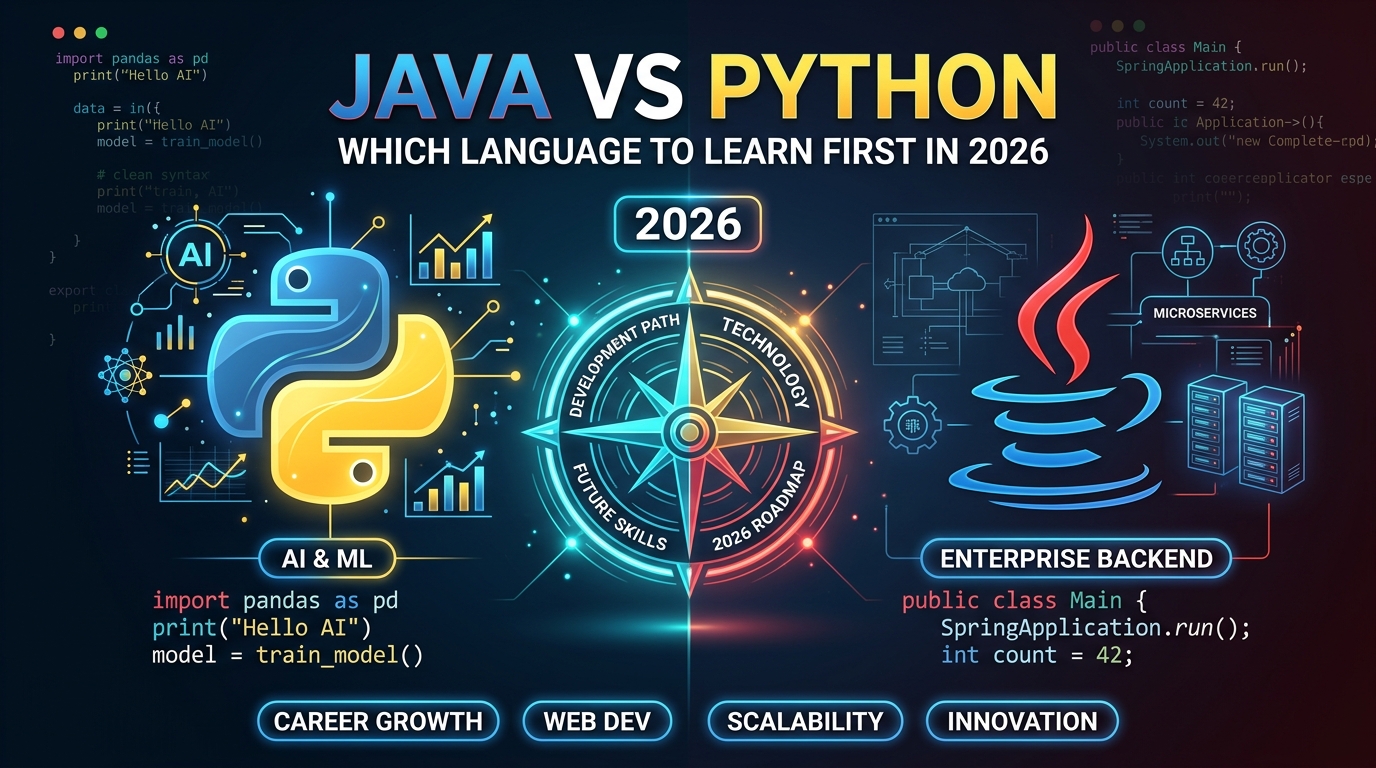
Java vs Python is one of the most persistent and defining debates beginners encounter when embarking on their software engineering journey. Both programming languages boast massive global ecosystems, battle-tested standard libraries, thriving developer communities, and lucrative career pathways — yet they were engineered around fundamentally different philosophical architectures.
Python is globally celebrated for its clean, English-like syntax, rapid prototyping speed, and uncontested dominance across artificial intelligence, machine learning, data science, automation, and backend APIs. Java, by contrast, has served for three decades as the rock-solid backbone of enterprise software, mission-critical banking infrastructure, large-scale distributed systems, and the global Android ecosystem.
In 2026, the question is no longer about which language is universally "superior" in the abstract. Instead, the right decision hinges squarely on what you want to build, which industry vertical you aim to enter, and where you want your tech career to head over the next five to ten years.
In this comprehensive, data-driven guide, we break down Java vs Python across learning difficulty, raw performance, job opportunities, AI/ML capabilities, web development frameworks, realistic compensation factors, and long-term industry scope — equipping you to choose your first programming language with absolute clarity.
🎁 Download Free Java vs Python Career Decision Guide — 2026
Not sure whether Java or Python is right for you? Download our free 2026 Java vs Python Career Guide and choose your learning path with confidence. Includes full comparison matrices, a 90-day learning roadmap, AI vs Enterprise decision trees, and beginner project blueprints.
Java vs Python: Quick Comparison
Before examining each parameter in depth, here is an executive side-by-side comparison of Python and Java across the core dimensions beginners evaluate:
| Feature | Python | Java |
|---|---|---|
| Beginner Friendly | ⭐⭐⭐⭐⭐ (Exceptional) | ⭐⭐⭐ (Moderate) |
| Syntax Structure | Clean, concise, indentation-based | Strict, verbose, class-based, curly braces |
| Performance | Good (Interpreted, dynamic typing) | Generally faster (JIT compiled, static typing) |
| AI & Machine Learning | ⭐⭐⭐⭐⭐ Excellent (Global standard) | ⭐⭐ Moderate (Limited libraries vs Python) |
| Data Science & Analytics | ⭐⭐⭐⭐⭐ Excellent (Pandas, NumPy, SciPy) | ⭐⭐⭐ Moderate (Weka, Deeplearning4j) |
| Backend Web Development | ⭐⭐⭐⭐ Excellent (Django, FastAPI, Flask) | ⭐⭐⭐⭐⭐ Excellent (Spring Boot, Jakarta EE) |
| Enterprise Software | ⭐⭐⭐ Good (Microservices, scripting) | ⭐⭐⭐⭐⭐ Excellent (Dominant in Fortune 500) |
| Scripting & Automation | ⭐⭐⭐⭐⭐ Excellent (Unmatched simplicity) | ⭐⭐ Moderate (Heavier runtime overhead) |
| Mobile / Android Dev | ⭐ Limited (Kivy, BeeWare) | ⭐⭐⭐⭐⭐ Strong ecosystem (Native JVM) |
| Learning Curve | Gentle & forgiving | Steeper initial conceptual curve |
| Best Suited For | AI, Data Science, Automation, Rapid APIs | Enterprise Backends, Banking, Large Systems |
Important Guidance Note: These star ratings represent a simplified, beginner-oriented comparative model based on typical first-time learning curves and contemporary industry utilization patterns, rather than absolute objective hardware benchmarks.
💻 Syntax At A Glance: "Hello World" Comparison
Python (1 line):
print("Hello, World!")
Java (5 lines):
public class HelloWorld {
    public static void main(String[] args) {
        System.out.println("Hello, World!");
    }
}
Notice how Python lets you test logic immediately, while Java requires you to understand classes, access modifiers, static keywords, string arrays, and system streams right from day one.
What Is Python?
Python is a high-level, dynamically typed, interpreted programming language conceived by Guido van Rossum and released in 1991. Built upon the philosophy that "readability counts" (as codified in the Zen of Python), the language prioritizes clear, intuitive syntax that closely resembles natural English.
Python is commonly used for:
- Artificial Intelligence (AI) & Generative AI: Large Language Model (LLM) agents, LangChain, LlamaIndex, neural reasoning engines.
- Machine Learning & Deep Learning: Predictive modeling with Scikit-learn, PyTorch, TensorFlow, and Keras.
- Data Science & Advanced Analytics: Data cleaning, transformation, and statistical modeling with Pandas, NumPy, and SciPy.
- Scripting & Task Automation: Automating repetitive OS tasks, web scraping with Beautiful Soup and Playwright, data pipelines.
- Web & API Development: Scalable backend microservices and REST APIs using FastAPI, Django, and Flask.
- Scientific Computing & Research: Bioinformatics, algorithmic quantitative finance, astronomy, and physics simulations.
Python's minimal boilerplate and gentle learning curve make it especially welcoming to individuals learning programming for the first time. You spend your early days learning core algorithmic thinking — loops, conditions, lists, and functions — rather than fighting compilation errors or intricate type definitions.
📊 Authoritative Industry Adoption Data
According to Stack Overflow's 2025 Developer Survey (encompassing over 49,000 professional developers across 177 countries, including 2,536 respondents / 7.2% from India), Python's overall adoption increased by 7 full percentage points year-over-year. This surge was directly fueled by the global revolution in Generative AI, machine learning tooling, and rapid backend data services. Furthermore, GitHub's 2025 Octoverse Report confirmed Python as the #2 most widely used programming language globally on GitHub (behind TypeScript), reflecting immense open-source contributor momentum.
What Is Java?
Java is a robust, class-based, object-oriented programming language designed by James Gosling at Sun Microsystems (now owned by Oracle) and released in 1995. Built around the famous architectural maxim "Write Once, Run Anywhere" (WORA), compiled Java code runs on any machine equipped with a Java Virtual Machine (JVM), regardless of underlying hardware or operating system.
Java is particularly powerful in:
- Enterprise Software Applications: Core banking systems, ERP software (SAP integrations), insurance processing, and airline reservation engines.
- Large-Scale Distributed Systems: Resilient microservices capable of handling millions of concurrent requests per second.
- Financial & Fintech Software: High-frequency algorithmic trading platforms, payment gateways, and regulatory compliance engines.
- The Android Ecosystem: Native Android OS infrastructure and legacy mobile apps (with Kotlin maintaining 100% two-way JVM interoperability).
- Big Data Processing: Distributed data computing platforms like Apache Hadoop, Apache Spark, and Apache Kafka.
- Cloud-Native Backend APIs: Enterprise RESTful and gRPC APIs powered by Spring Boot, Quarkus, and Jakarta EE.
Java's comprehensive ecosystem is anchored by industrial-strength frameworks like Spring and Spring Boot, which power the transactional backends of the vast majority of Global Fortune 500 corporations. When reliability, strict type safety, predictable garbage collection, and multi-threaded scaling are paramount, Java remains the corporate standard.
Java vs Python: Key Differences
To understand which language fits your profile, let's examine the key architectural and practical differences across eight fundamental dimensions.
1. Syntax and Ease of Learning
Python utilizes indentation (whitespace) to delineate code blocks, discarding semicolons, curly braces, and verbose boilerplate. Variables are dynamically typed, meaning you do not declare whether a variable is an integer, string, or boolean beforehand.
Java, in contrast, is strictly and statically typed. Every variable must have an explicit data type declared, every statement must end with a semicolon, and code must reside within structured classes. Java introduces students immediately to concepts like access modifiers (public, private, protected), static memory, object instantiation, packages, and interfaces.
While this makes Java feel more intimidating during week one, it also forces learners to understand how computer memory, classes, and object hierarchies actually work under the hood.
Verdict for Complete Beginners: 🏆 Python (Much faster path to writing functional programs).
2. Performance and Execution Speed
Java has a significant, mathematically measurable advantage when raw runtime execution speed and high-throughput CPU processing are required. Java source code compiles into JVM bytecode, which is further optimized at runtime into native machine code by the Just-In-Time (JIT) compiler.
Python is an interpreted language (standard CPython). While Python's high-level execution is slower for CPU-bound computation, modern Python applications circumvent this limitation by binding computationally heavy tasks to C/C++ libraries (such as NumPy or PyTorch) or deploying asynchronous runtime engines (FastAPI with Uvicorn).
- Choose Java when: You are building high-frequency trading platforms, multi-threaded payment engines, or services requiring microsecond-level latency.
- Choose Python when: Developer iteration speed, agile feature release, and flexibility outweigh sub-millisecond execution times.
3. Career Opportunities
Both languages command massive hiring markets across India (Gurugram, Bengaluru, Hyderabad, Pune, Noida) and international tech hubs, but they funnel candidates into distinct departmental profiles:
- Python Career Funnel: Data Analyst, Data Scientist, Machine Learning Engineer, Generative AI Specialist, Python Backend Developer, DevOps/Automation Engineer.
- Java Career Funnel: Core Java Developer, Spring Boot Microservices Architect, Enterprise Application Engineer, Android Developer, Big Data Engineer.
4. Web Development
Both languages provide exceptional backend web engineering ecosystems:
- Python Frameworks: Django (the "batteries-included" framework ideal for monolithic apps and rapid MVPs), FastAPI (modern, lightning-fast asynchronous API development with automatic OpenAPI docs), and Flask (lightweight micro-framework).
- Java Frameworks: Spring Boot (the global enterprise industry standard with dependency injection, security, and cloud integrations), Micronaut, and Quarkus (tailored for ultra-fast containerized cloud deployments).
5. AI and Machine Learning
This is the single area where Python holds an overwhelming, insurmountable advantage. Virtually the entire global artificial intelligence research community, from OpenAI and Google DeepMind to Meta AI and Hugging Face, writes and publishes frameworks natively in Python.
With libraries like PyTorch, TensorFlow, Scikit-learn, LangChain, and Transformers, Python is the unquestioned lingua franca of AI. While Java has tools like Deeplearning4j, they represent a fraction of the AI tooling ecosystem.
Verdict for AI/ML: 🏆 Python (Decisive, clear winner).
6. Android Development
Android's native runtime environment was built from the ground up around Java. While Google named Kotlin the preferred language for Android development in 2019, Kotlin compiles directly to JVM bytecode and maintains 100% bidirectional interoperability with Java. A Java developer can seamlessly transition to Android development.
Python has frameworks like Kivy and BeeWare for cross-platform mobile apps, but they are rarely used in commercial production mobile applications.
Verdict for Android: 🏆 Java.
7. Enterprise Software
Enterprise software requires backwards compatibility across decades, strict compile-time error checking, robust transaction isolation, and predictable maintenance across teams of hundreds of engineers. Java's static typing, mature tooling (IntelliJ IDEA, Eclipse), and ubiquitous enterprise libraries make it the undisputed titan of Fortune 500 corporate IT.
Verdict for Enterprise: 🏆 Java.
8. Community and Learning Resources
Both languages rank among the top 4 most supported programming languages in history. Whether you run into an obscure error in Python or Java, thousands of detailed solutions exist on Stack Overflow, GitHub discussions, and official documentation.
Python's package registry (PyPI) hosts over 500,000 open-source libraries, while Java's Maven Central repository features virtually every enterprise utility imaginable.
Java vs Python for Beginners
When you are completely new to coding, the primary enemy is not lack of intelligence — it is cognitive overload. If you spend your first two weeks memorizing curly braces, static methods, class inheritance rules, and classpath configurations before seeing your first calculation output, motivation evaporates quickly.
This is why top computer science institutions, including MIT, Stanford, and Harvard, transitioned their introductory programming courses (like Harvard's CS50) to include or prioritize Python. Python lets beginners focus directly on problem-solving concepts:
- What is an algorithm?
- How does a loop iterate over elements?
- How do conditional statements alter control flow?
- How do data structures like lists, dictionaries, and sets organize information?
Once you master those universal computing concepts in Python, transitioning to Java later is remarkably straightforward because the underlying logic remains identical.
Java vs Python for Jobs in 2026
Both languages provide immense employment opportunities, but smart students must understand an uncomfortable industry reality in 2026:
⚠️ The "Language Alone Is Not Job-Ready" Rule
Simply putting "Python" or "Java" on your resume will not land you a developer job in 2026. Companies hire for complete production-grade stacks, not isolated syntax awareness.
✅ The Employable Python Stack
Writing basic scripts is not enough. An entry-level hire is expected to possess:
- Core Python + Object-Oriented Programming
- Relational Databases & Advanced SQL (PostgreSQL, MySQL)
- Git & GitHub collaborative workflows
- Backend Web Framework: FastAPI or Django
- REST API design, JWT authentication, and Postman testing
- Docker containerization basics + Cloud deployment (AWS / Render)
- 2–3 deployed, production-ready portfolio projects
✅ The Employable Java Stack
Knowing Java fundamentals without frameworks leaves you stranded. An employable candidate needs:
- Core Java (OOP, Collections Framework, Multithreading, Streams)
- Relational Databases, SQL & JPA / Hibernate ORM
- Spring Boot (Controllers, Services, Repositories, Security)
- Microservices Architecture & RESTful API creation
- Build tools (Maven or Gradle) & Git version control
- Unit Testing with JUnit and Mockito
- Full-stack integration with Angular or React
According to the 2025 Stack Overflow survey, 69% of active developers reported learning a new coding technique or language during the previous year, and 84% reported actively using or planning to use AI-assisted tools in their daily workflow. Adaptability and full-stack competence, not rigid language loyalty, define successful careers today.
Java vs Python for AI and Machine Learning
If your ultimate ambition is to work in Artificial Intelligence, Data Science, or Generative AI, Python is not merely the recommended choice — it is essentially non-negotiable.
Python's ecosystem provides a seamless bridge from basic data cleaning to cutting-edge model training. Here is the verified step-by-step learning progression followed by successful AI engineers:
Python Fundamentals & Logic
Variables, data types, conditional loops, functions, and list/dict manipulations.
NumPy + Pandas (Data Wrangling)
Vectorized array mathematics, tabular data filtering, merging datasets, handling missing values.
SQL & Relational Databases
Complex joins, window functions, aggregations, and querying live production data.
Statistics & Exploratory Data Analysis
Distributions, hypothesis testing, correlation, and data visualization (Matplotlib & Seaborn).
Machine Learning with Scikit-Learn
Linear regression, decision trees, random forests, gradient boosting (XGBoost), model evaluation.
Deep Learning & AI Deployment
Neural networks in PyTorch, computer vision, NLP transformers, LangChain, and production APIs.
Java vs Python for Web Development
When selecting a language for backend web engineering, your choice should align with the size and operational style of the organization you want to work for:
- Startups, Agile Teams & AI Startups: Typically favor Python (FastAPI or Django). They need to build features rapidly, iterate based on user feedback, and integrate easily with external machine learning endpoints or data scrapers.
- Multinational Corporations, Banks & IT Services Giants: Heavily favor Java (Spring Boot). Organizations like TCS, Infosys, Wipro, Accenture, Cognizant, HDFC Bank, and American Express maintain massive Java codebases that process billions of financial transactions daily.
Neither is superior in isolation; they serve different organizational operational rhythms.
Java vs Python Salary and Career Scope
Many online articles publish misleading fixed assertions such as "Python developers make ₹X while Java developers make ₹Y." In reality, compensation in India's software engineering market is not determined by the programming language itself. It is driven by eight concrete variables:
Understanding caching (Redis), message queues (Kafka), and database indexing.
Technical interview performance on data structures and algorithms.
Product-based firms (FAANG, Unicorns) vs service-based IT consultants.
Cyber Hub Gurugram, Bengaluru, and Hyderabad command 20–35% higher compensation.
For example, a senior engineer with mastery over Java + Spring Boot + Microservices + Distributed Caching can command ₹18–35+ LPA in top tier firms. Equally, a specialist proficient in Python + Machine Learning + Cloud APIs + LangChain easily secures identical or higher compensation packages. The language is merely a vehicle; your depth of software engineering problem-solving is the true value driver.
Which Is Easier: Java or Python?
For almost every newcomer, Python is demonstrably easier to begin with.
In Python, you do not have to battle with type mismatches, missing semicolons, or complex file naming rules where the class name must exactly match the filename on disk. When code fails, Python outputs straightforward tracebacks pointing directly to the offending line.
In Java, errors frequently manifest as compiler errors before you can even run the program. While this prevents runtime bugs in large teams, it creates immediate friction for a beginner who simply wants to see if their math formula works.
However, if your university syllabus or specific target employer demands Java, learning Java first is by no means an insurmountable hurdle — it simply requires patience and structured mentorship during the first month.
Should You Learn Java or Python First in 2026?
To eliminate ambiguity, use this actionable career decision matrix to pinpoint your ideal starting language:
| Your Current Career Goal | Recommended First Language | Core Rationale |
|---|---|---|
| Completely new to coding | Python | Gentle syntax lets you learn algorithmic logic without compiler frustration. |
| Artificial Intelligence / ML | Python | Global standard; all major research and model frameworks are Python-native. |
| Data Science & Analytics | Python | Unrivaled data manipulation libraries (Pandas, NumPy, Matplotlib). |
| Process Automation & Scripting | Python | Fastest language for building scrapers, bots, and OS automation scripts. |
| Enterprise Software / Banking | Java | Standard corporate framework for financial systems and high-throughput backends. |
| Spring Boot Backend Development | Java | Spring Boot is the most widely deployed backend framework in Fortune 500 IT. |
| Android Application Development | Java | Direct JVM architecture foundation; seamless transition to Kotlin. |
| Want Deep Object-Oriented Principles | Java | Strict typing enforces solid architectural design patterns from day one. |
| Unsure About Career Direction | Python | Maximum versatility across web, AI, data, and automation. |
🎯 The Golden Decision Rule:
Choose Python first if you prioritize rapid learning, flexibility, automation, or any path leading toward AI and Data Science.
Choose Java first if you know with certainty that you want to enter enterprise software engineering, banking IT, or large-scale backend systems.
Java vs Python: Pros and Cons
🐍 Python: Strengths & Limitations
PROS:- Clean, English-like, highly readable syntax
- Gentle learning curve that accelerates beginner confidence
- Uncontested global leadership in AI, ML, and Data Science
- Incredible library ecosystem for scripting and automation
- Lightning-fast development velocity for prototypes and MVPs
- Slower raw execution speed for CPU-bound computations
- Dynamic typing can permit runtime bugs in poorly tested apps
- Limited native presence in mobile (Android/iOS) development
☕ Java: Strengths & Limitations
PROS:- Superior multi-threaded runtime speed and throughput
- Mature, battle-tested enterprise ecosystem (Spring Boot)
- Strict static typing prevents entire classes of runtime errors
- Write Once, Run Anywhere (WORA) on any JVM architecture
- Rock-solid backing across Fortune 500 banks and IT giants
- Verbose syntax requiring extensive boilerplate code
- Steeper initial learning curve for absolute beginners
- Significantly weaker native ecosystem for modern AI and ML
Final Verdict
There is no universally victorious language in the Java vs Python comparison — only the language that best fits your immediate aspirations.
If you are standing at the starting line in 2026 without prior coding experience, Python offers the smoother, more versatile on-ramp. It gives you immediate feedback, teaches you fundamental programming logic, and opens doors to the explosive frontiers of AI and data science.
If your sights are set squarely on corporate IT infrastructure, fintech banking platforms, or large-scale backend systems, Java provides an uncompromising, disciplined foundation that has powered corporate computing for thirty years and will continue doing so for decades to come.
The single worst thing you can do is spend months trapped in analysis paralysis comparing languages. Pick one, commit to building hands-on projects, master relational databases and version control, and become a genuine problem solver. Once you master your first language, learning your second takes a fraction of the time.
Download Free Java vs Python Career Decision Guide — 2026
Keep this printable decision matrix, 90-day learning roadmap, interview skill checklist, and portfolio project ideas with you as you plan your coding journey.
Recommended Industry-Aligned Training Programs
Aptech Learning Gurugram provides structured classroom and hybrid diploma tracks with live project coaching, GitHub portfolio reviews, and dedicated placement support:
Smart Pro Python Web Development Track →
Comprehensive hands-on program covering Core Python, Django, REST APIs, SQL, and cloud deployment.
Smart Pro Java Web Development Track →
Master Core Java, Spring Boot, Microservices, Hibernate, and full-stack enterprise API engineering.
Smart Pro Data Science & AI Track →
Master Python for data analytics, machine learning algorithms, deep learning neural nets, and AI applications.
SQL vs Python vs R Decision Guide →
Compare database querying against programming and statistical computing for data careers.
Frequently Asked Questions (FAQs)
Q1. Is Python better than Java in 2026?
Not universally. Python is significantly stronger and more widely used in artificial intelligence, machine learning, data science, and rapid task automation. Conversely, Java remains the undisputed industry standard for high-throughput enterprise software, banking infrastructure, distributed systems, and Spring Boot backend engineering.
Q2. Should I learn Python or Java first as a beginner?
Python is generally the recommended first language for complete beginners because its clean, readable syntax eliminates boilerplate code and allows you to master core algorithmic thinking without fighting strict compiler errors. However, if your immediate goal is enterprise backend development or your university curriculum focuses heavily on object-oriented programming, learning Java first is also a solid path.
Q3. Which has more jobs, Java or Python?
Both languages command massive global job markets. Python dominates hiring in AI, machine learning, data engineering, and startup web backends. Java dominates enterprise software, banking, financial services, and large-scale corporate IT services. In 2026, recruiters prioritize candidates who know a complete technology stack (such as Python + SQL + FastAPI or Java + Spring Boot + Microservices) over those who merely know basic syntax.
Q4. Is Java harder than Python?
Java has a steeper initial learning curve because beginners must understand static typing, classes, access modifiers (public/private), and the Java Virtual Machine (JVM) right from their very first program. Python allows beginners to write functional logic in a single line of code without declaring classes or types.
Q5. Should I learn Java after Python?
Yes, absolutely. Learning Java after mastering Python is an excellent way to broaden your software engineering foundation. Experiencing both dynamically typed and statically typed languages deepens your understanding of memory management, design patterns, and system architecture, making you a much more versatile developer.
📞 Need Help Choosing Between Java and Python?
Speak with EduQuest's senior academic advisors and faculty mentors at +91 99580 41888 or visit our counseling center at Galleria Market, DLF Phase-IV, Sector 28, Gurugram. We will evaluate your educational background, timeline, and career ambitions to guide you toward the optimal programming track.