

Generative AI has officially moved out of experimental research labs and directly into everyday business operations. By 2026, it is a core engine behind how enterprises build software, automate business workflows, craft marketing campaigns, and analyze big data — not just a novelty for big tech. For students, fresh graduates, and working tech professionals, this shift has opened up an unprecedented wave of high-paying career opportunities — but it has also made "just learn AI" a vague and confusing piece of advice.
This comprehensive guide breaks down the real, in-demand career paths in generative AI, the exact technical and soft skills employers evaluate in interviews, and a step-by-step learning roadmap so you know exactly where to begin.
Download Free Generative AI Careers & Skills Checklist (PDF)
Get instant access to complete role-by-role skill checklists, RAG & LLM tool stack matrices, salary benchmarks, and portfolio project formulas.
Why Generative AI Careers Are Growing So Fast
Industry estimates confirm that over 80% of global enterprises will have deployed generative-AI-enabled applications or specialized copilots by 2026. What was once considered a specialized research niche is now an operational baseline. Companies across banking, healthcare, retail, e-commerce, and logistics are embedding custom LLMs to automate customer interactions, analyze internal knowledge bases, and write code.
However, while demand for AI talent has surged, the pool of candidates with hands-on, production-level skills remains remarkably thin. This creates a massive opportunity for professionals who develop structured, practical expertise in building generative systems. Importantly, this isn't only a coding opportunity: generative AI careers span pure engineering, product management, creative content strategy, and AI governance.
The 6 Main Generative AI Career Paths in 2026
1. Generative AI Engineer
Core Technical BuilderDesigns and deploys generative AI systems that synthesize text, code, or multimodal outputs. Builds retrieval-augmented generation (RAG) pipelines and connects LLMs to corporate databases.
2. Machine Learning / MLOps & LLMOps Engineer
Infrastructure & ScalingFocuses on model training, fine-tuning, automated CI/CD deployment pipelines, low-latency inference serving, and monitoring model drift in production environments.
3. Prompt Engineer & AI Interaction Designer
Human-AI InteractionArchitects and optimizes structured prompts, context windows, few-shot examples, and safety guardrails to ensure deterministic, enterprise-grade output from foundation models.
4. AI Product Manager
Strategy & DeliveryBridges business goals with AI engineering capabilities. Identifies high-ROI generative AI use cases, scopes model performance metrics, and designs user experiences around probabilistic AI features.
5. AI Content Strategist & Creative Technologist
Creative & MarketingLeverages multimodal AI tools (Midjourney, Runway, Claude, GPT-4) to scale high-quality creative assets, copy, video generation, and personalized marketing campaigns.
6. AI Ethics, Safety & Governance Specialist
Compliance & RiskEnsures corporate AI deployments adhere to legal regulations, copyright protections, bias mitigation protocols, and international safety frameworks (EU AI Act, NIST AI RMF).
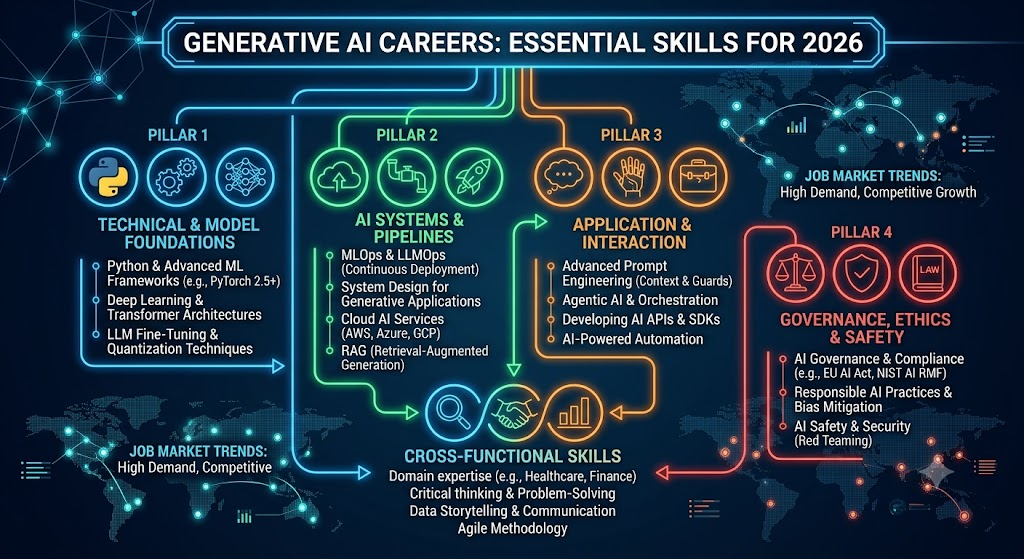
The 4 Essential Pillars of Generative AI Skills (2026 Framework)
To become truly competitive in the job market, candidates need a cohesive balance across these four key pillars:
Technical & Model Foundations
- Python & ML Frameworks (PyTorch 2.5+)
- Deep Learning & Transformer Architectures
- Attention Mechanisms & Embeddings
- Fine-Tuning & Quantization (PEFT, LoRA)
AI Systems & Pipelines
- MLOps & LLMOps (Continuous Delivery)
- Retrieval-Augmented Generation (RAG)
- Vector DBs & Semantic Search (Pinecone)
- Cloud AI (AWS Bedrock, Azure OpenAI)
Application & Interaction
- Advanced Prompt Engineering & Guardrails
- Agentic AI & Multi-Agent Orchestration
- Developing AI APIs & Custom SDKs
- AI-Powered Robotic Process Automation
Governance, Ethics & Safety
- AI Governance & Compliance (EU AI Act)
- Responsible AI & Bias Mitigation
- AI Safety & Security (Red Teaming)
- Hallucination Detection & Fact-Checking
🤝 Non-Technical / Cross-Functional Skills That Win Offers
Domain Expertise (knowing healthcare, finance, or retail workflows), Critical Thinking & Problem Solving, Data Storytelling & Executive Communication, and Agile AI Experimentation are often what differentiate candidates who get hired from candidates who only know syntax.
A Practical 5-Step Roadmap to Get Started
Master Programming & Math Baseline (Weeks 1–6)
Solidify Python fundamentals, OOP, NumPy, pandas, linear algebra, and basic neural network concepts.
Understand Transformers & LLM APIs (Weeks 7–12)
Learn self-attention, encoder-decoder models, tokenization, HuggingFace transformers, and build applications utilizing OpenAI/Anthropic APIs.
Build Advanced RAG & Multi-Agent Systems (Weeks 13–18)
Connect models to external knowledge with LangChain, LlamaIndex, chunking strategies, hybrid search, and LangGraph multi-agent teams.
Develop a Real-World Production Portfolio (Weeks 19–24)
Host 3 live AI applications (e.g. specialized financial document QA, code review agent, or automated multimodal generator) with Docker and cloud hosting.
Validate with Recognized Industry Certifications
Pursue NASSCOM and enterprise-aligned certifications (such as Aptech's Smart Pro AI tracks) to stand out in corporate recruitment drives.
Common Myths, Busted
- "You need a Ph.D. in Computer Science to work in GenAI." False. While foundation model research requires deep research credentials, 90% of open industry roles focus on application engineering, fine-tuning, RAG, and product integration, which can be mastered through structured practical training.
- "Prompt engineering is just a temporary buzzword." False. Enterprise prompt engineering involves systematic latency benchmarking, output evaluation, context caching, and guardrail enforcement — essential skills for scalable software.
- "You have to master every single AI tool at once." False. Focus on your specific track (e.g. Python + RAG for Engineers, or AI Tool Fluency + Scoping for Product Managers) rather than spreading yourself too thin.
Recommended Industry-Aligned Training Tracks
Aptech Learning Gurugram provides structured classroom and hybrid programs with live project coaching and placement drives:
Smart Pro Data Science & AI Track →
Comprehensive 9-month professional track covering Python, Deep Learning, Generative AI & MLOps.
SQL vs Python vs R Guide →
Compare learning curves, career paths, and deciding what to learn first for data and AI careers.
Data Science Portfolio Blueprint →
Step-by-step formula for building 3-6 GitHub portfolio projects that get you hired without job experience.
Frequently Asked Questions (FAQs)
Q1. Is generative AI a good career choice for beginners in 2026?
Yes. With structured learning of Python, machine learning basics, transformers, and API-driven development, beginners can build a strong portfolio and access high-growth roles across technology, finance, and product management.
Q2. Do I need to know how to code for a generative AI career?
Not always. Technical roles (AI Engineer, MLOps) require strong Python programming skills, but roles like AI Product Manager, AI Content Strategist, and AI Transformation Manager rely more heavily on domain expertise, AI literacy, and strategic scoping.
Q3. What is the fastest generative AI skill to learn?
Prompt engineering, context optimization, and generative tool literacy (ChatGPT, Claude, Midjourney) can be picked up in a few weeks and applied immediately to current workflows.
Q4. Which generative AI career pays the most?
Generative AI Engineers, LLMOps Architects, and senior AI Product Managers command the highest packages, often ranging between ₹18 LPA and ₹45+ LPA at mid-to-senior levels in India's major tech hubs.
Download the 2026 Generative AI Career Checklist PDF
Keep this printable checklist of technical skills, tool stacks, interview questions, and portfolio formulas handy as you prepare for generative AI roles.
Final Word
Generative AI careers in 2026 aren't limited to a single rigid path — they span technical engineering, product leadership, creative storytelling, and regulatory governance. The professionals who move fastest are those who select a track early, build working project evidence on GitHub, and continuously upgrade their skills as foundation models evolve.
📞 Need Personalized Guidance for Your AI Career?
Talk to EduQuest's AI academic counselors at +91 99580 41888 or visit our training center at Galleria, DLF Phase-IV, Gurugram. We'll help you map out the ideal learning path for your career goals.