

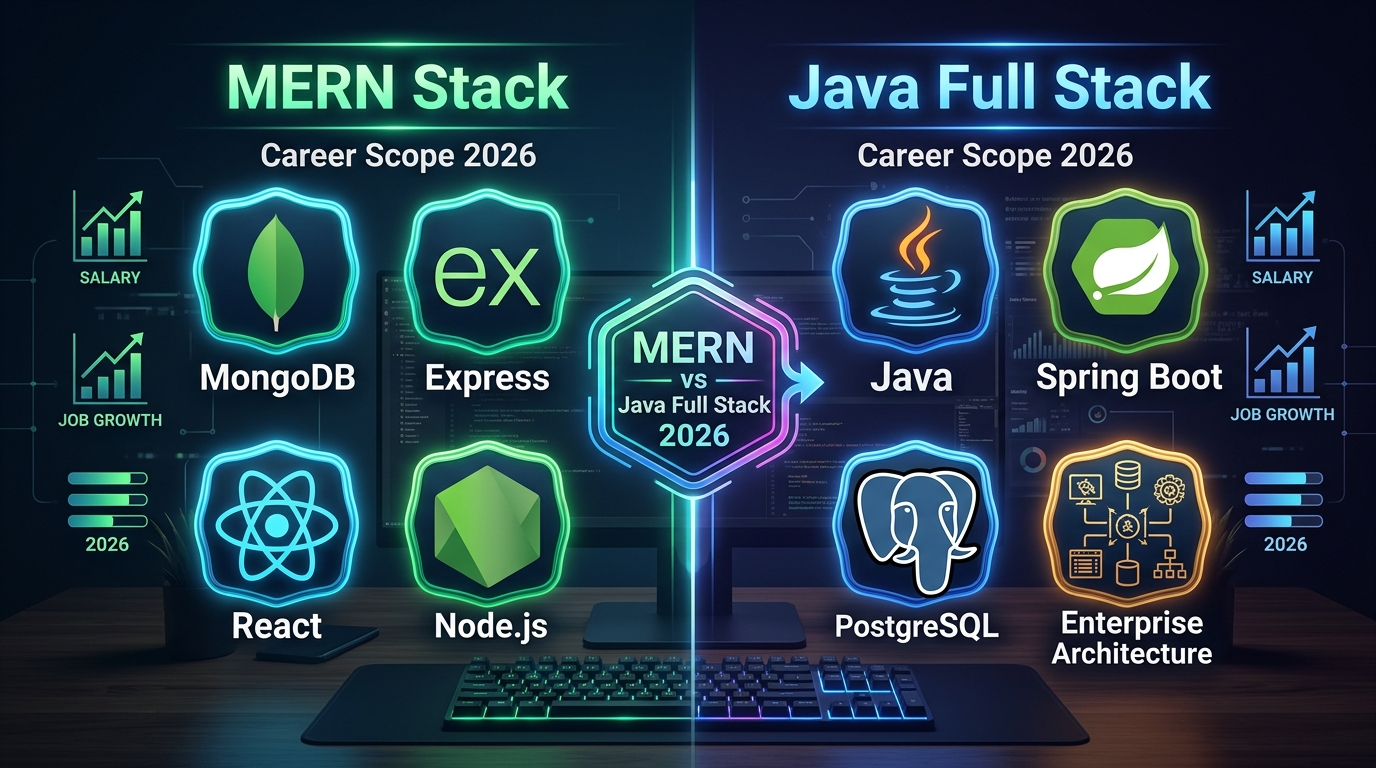
If you are preparing to build a career as a full-stack software engineer in 2026, two heavyweight technology paths dominate job descriptions across India and global remote markets: MERN Stack and Java Full Stack.
Both stacks empower developers to engineer complete, end-to-end web applications — from dynamic interactive user interfaces to robust database storage. However, they are anchored in fundamentally different architectural philosophies, company cultures, and engineering ecosystems.
The MERN Stack (MongoDB, Express.js, React, Node.js) provides a streamlined, single-language JavaScript/TypeScript ecosystem celebrated for rapid feature iteration, startup velocity, and dynamic JSON document flexibility. Conversely, Java Full Stack (Java, Spring Boot, SQL, React/Angular) provides a rock-solid, statically typed corporate powerhouse that runs the transactional backends of Fortune 500 banks, insurance conglomerates, and large-scale IT consulting giants.
So, which stack has better career scope in 2026? In this comprehensive, data-driven comparison, we break down both technology stacks across frontend, backend, databases, learning difficulty, Indian job opportunities, realistic salary factors, startup vs enterprise dynamics, and step-by-step roadmaps to help you choose the right path.
🎁 Download Free: MERN vs Java Full Stack — Career Decision Guide 2026
Still deciding between MERN and Java Full Stack? Download our free 2026 Career Decision Guide. Features side-by-side stack comparisons, skills checklists, 10 portfolio project ideas, a 6-month learning schedule, and interview preparation questions.
What Is the MERN Stack?
The MERN Stack is a popular JavaScript-centric collection of technologies designed to build modern full-stack web applications. It stands for:
- M — MongoDB: A flexible NoSQL document database storing data as JSON-like BSON objects.
- E — Express.js: A minimalist backend web framework running on top of Node.js to structure REST APIs and middleware.
- R — React: The world's leading frontend UI library for building interactive component-driven single-page applications.
- N — Node.js: An open-source, asynchronous JavaScript runtime built on Chrome's V8 engine that executes JavaScript on servers.
What Is Java Full Stack?
Java Full Stack refers to a robust software architecture where Java powers the backend application logic and data access, paired with a modern frontend framework and a relational database:
- Frontend: React.js or Angular.
- Backend: Java + Spring Boot (Controllers, Services, Repositories, Dependency Injection).
- Data Access: JPA / Hibernate (ORM) or raw JDBC for high-throughput batching.
- Database: Relational SQL databases such as PostgreSQL, MySQL, or Oracle Database.
MERN Stack vs Java Full Stack: Quick Comparison
| Dimension | MERN Stack | Java Full Stack |
|---|---|---|
| Frontend Layer | React.js (Next.js) | React.js or Angular |
| Backend Layer | Node.js + Express.js | Java + Spring Boot |
| Core Language | JavaScript / TypeScript (Single language) | Java (Backend) + JS/TS (Frontend) |
| Primary Database | MongoDB (NoSQL Document Store) | PostgreSQL / MySQL (Relational SQL) |
| API Architecture | REST APIs / GraphQL | REST APIs / gRPC / Microservices |
| Learning Curve | ⭐⭐⭐ Moderate (Gentler for beginners) | ⭐⭐⭐⭐ Moderate–High (Strict OOP & Types) |
| Startup Adoption | ⭐⭐⭐⭐⭐ Extremely High (Rapid MVPs) | ⭐⭐⭐ Moderate (Heavier initial setup) |
| Enterprise Adoption | ⭐⭐⭐⭐ Growing rapidly | ⭐⭐⭐⭐⭐ Dominant in Fortune 500 & Banking |
MERN vs Java Full Stack: Layer-by-Layer Comparison
1. Frontend Comparison (Almost Identical)
Interestingly, the frontend is where MERN and Java Full Stack are closest. Both modern MERN developers and Java Full Stack developers frequently build client interfaces using React.js and TypeScript. A component, hook, or state management store (Redux/Zustand) written in React works identically whether talking to a Node.js server or a Java Spring Boot server.
2. Backend Comparison (The Big Divide)
The backend is where the philosophies diverge completely:
- Node.js (MERN): Single-threaded, event-driven, non-blocking I/O runtime. It excels at handling thousands of lightweight concurrent I/O operations (chats, live feeds, dashboards) with rapid developer velocity.
- Spring Boot (Java): Multi-threaded, strongly typed enterprise framework. It excels at heavy CPU computation, complex transactional financial logic, and enforcing strict architectural boundaries across large teams.
3. Database Comparison (NoSQL vs Relational SQL)
- MongoDB (MERN): Stores nested JSON documents. It offers dynamic schema flexibility, making it easy to iterate rapidly during early startup phases.
- SQL / PostgreSQL (Java Full Stack): Enforces strict table schemas, foreign key relationships, and ACID transaction guarantees. In enterprise banking, an inconsistent schema is a catastrophic bug; hence, SQL remains mandatory.
Pro Tip: In modern industry, MERN developers frequently replace MongoDB with PostgreSQL (forming the PERN stack). Never neglect SQL fundamentals.
Learning Difficulty: Which Is Easier for Beginners?
For complete beginners, MERN Stack offers a gentler, more intuitive on-ramp. Because you use JavaScript (or TypeScript) across both the frontend and backend, you only need to master one programming language, one syntax, and one package ecosystem (npm).
Java Full Stack requires learning two distinct language paradigms: JavaScript/TypeScript for the frontend and Java (with strict OOP, static typing, JVM nuances, and Maven) for the backend. While this creates more initial friction, it also builds an uncompromisingly solid computer science foundation.
Job Opportunities in India: MERN vs Java Full Stack
Both stacks command enormous hiring volume across Indian tech hubs (Cyber City Gurugram, Bengaluru, Hyderabad, Pune, Noida), but the hiring companies differ:
🚀 MERN Stack Job Landscape
- Dominates product startups, digital agencies, and SaaS scale-ups
- Common titles: React Developer, Full Stack JavaScript Engineer, Node.js Backend Engineer
- Valued for fast feature shipping and modern UI mastery
🏦 Java Full Stack Job Landscape
- Dominates MNC banks (HDFC, SBI, Barclays, Citi), GCCs, and IT service giants (TCS, Infosys, Wipro, Accenture)
- Common titles: Java Full Stack Engineer, Spring Boot Developer, Software Engineer
- Valued for long-term system stability, security, and scalability
Salary Factors: Which Pays Better in India?
Do not believe sensational claims that "Java developers automatically earn 5 LPA more than MERN developers." In reality, compensation in India depends on company tier (Product Unicorns / GCCs vs Service Agencies), system design depth, problem-solving skills, and years of experience.
A top-tier React + Node.js engineer in a Gurugram unicorn often earns ₹15–25 LPA, while an entry-level Java dev in a traditional service firm starts at ₹4–6 LPA. Conversely, a senior Java Spring Boot architect at a global fintech firm can easily command ₹30–50+ LPA. Your mastery of architecture, caching, and databases determines your salary, not the acronym on your resume.
Which Full Stack Should You Choose in 2026?
| Your Career Goal | Recommended Choice | Why |
|---|---|---|
| Fastest path to job-readiness | MERN Stack | Single language (JavaScript) reduces cognitive overhead. |
| Targeting startups & modern SaaS | MERN / Next.js | Startups prize rapid prototyping and React/Node ecosystems. |
| Targeting MNC banks & Global Enterprise | Java Full Stack | Spring Boot is the undisputed standard in financial IT. |
| Want deep Object-Oriented CS fundamentals | Java Full Stack | Strict typing teaches architectural discipline early. |
| Prefer UI, design & interactive frontend | MERN Stack | Deep focus on React, animations, and client-side state. |
Common Mistakes When Choosing a Full Stack
- Mistake 1: Trying to Learn Both Stacks Simultaneously: Attempting to learn React, Node, Express, Java, Spring Boot, and SQL at the same time leads to confusion and burnout. Pick one stack and build 3 production projects first.
- Mistake 2: Learning Frameworks Without Language Fundamentals: Becoming a "React developer who doesn't understand pure JavaScript" or a "Spring Boot developer who doesn't understand Core Java OOP" makes technical interviews nearly impossible to pass.
- Mistake 3: Treating MongoDB as a Substitute for SQL: Even if you choose MERN, you must learn relational SQL (PostgreSQL). 90% of enterprise backends rely on relational data integrity.
Final Verdict
There is no loser in the MERN Stack vs Java Full Stack debate. If you want a faster, web-first on-ramp into modern startups and product teams, choose MERN Stack. If you want bulletproof enterprise stability, banking backends, and strict OOP engineering, choose Java Full Stack.
Commit to one stack for the next six months, master relational databases and Git, deploy live projects, and become a genuine problem solver.
Download Free: MERN vs Java Full Stack — Career Decision Guide 2026
Keep this printable 9-page decision tree, skills matrix, 6-month study schedule, and interview cheat sheet with you as you choose your tech path.
Recommended Industry-Aligned Training Tracks
Aptech Learning Gurugram provides hands-on full-stack tracks with live coding mentorship and dedicated placement support:
Smart Pro Java Web Development Track →
Master Core Java, Spring Boot, Microservices, Hibernate, and enterprise API architecture.
Smart Pro Python Web Development Track →
Master Core Python, Django, REST APIs, SQL, and full-stack cloud deployment.
Full Stack Developer Roadmap 2026 →
Step-by-step roadmap covering HTML, CSS, JavaScript, React, Node.js, and SQL.
.NET Developer Career Path & Salary →
Master C#, ASP.NET Core, SQL Server, Entity Framework, and Azure cloud services.
Frequently Asked Questions (FAQs)
Q1. Which is better, MERN or Java Full Stack in 2026?
Neither is universally better. MERN is optimal for modern web applications, startups, and agile SaaS products using React and JavaScript. Java Full Stack is ideal for enterprise banking, financial transactions, and large-scale corporate IT backends.
Q2. Is MERN easier than Java Full Stack?
Yes. MERN is generally easier for beginners because JavaScript is used across both client and server, reducing cognitive overhead compared to learning Java OOP and Spring Boot alongside JavaScript.
Q3. Which has more jobs in India?
Both have massive hiring volume. MERN leads in product startups and digital product agencies, while Java Full Stack leads across Global Capability Centers (GCCs), MNC banks, and IT consulting enterprises.
Q4. Which stack offers a higher salary?
Neither stack guarantees a higher salary. Compensation is dictated by candidate depth in system design, database tuning, problem-solving, and company tier (product unicorn vs service consultancy).
Q5. Should I learn MERN and Java Full Stack together?
No. Beginners should choose one stack, build 3 to 4 deployed production projects, and achieve job-readiness before attempting to learn a second backend ecosystem.
Q6. Is Java Full Stack still relevant in 2026?
Yes, emphatically. Java and Spring Boot power the vast majority of global financial transactions, telecommunication platforms, and Fortune 500 corporate infrastructures.
Q7. Is MERN still relevant in 2026?
Yes. React and Node.js remain the world's most widely deployed web technologies, especially when paired with TypeScript and relational databases like PostgreSQL.
Q8. Which is better for freshers?
MERN is often preferred by web-focused freshers seeking faster project results. Java Full Stack is ideal for freshers targeting campus placements in top IT services and enterprise MNCs.
📞 Still Deciding Between MERN and Java Full Stack?
Talk to EduQuest's senior full-stack mentors at +91 99580 41888 or visit our counseling campus at Galleria Market, DLF Phase-IV, Sector 28, Gurugram. We will evaluate your technical aptitude and career aspirations to help you choose the winning path.